
Why Prop Challenges Fail in 2026
Prop firm challenges are not solely a strategy test—they are a contractual risk test. In 2026, evaluation models layer daily loss caps, trailing equity drawdowns, minimum trading days, and consistency thresholds. You can have a positive expectancy and still fail if your sizing ignores those contracts.

Retail traders treat challenges like a hustle sprint: increase risk, chase targets, trade every session. Firms price their model around survivors who are dull on risk. The edge that “feels conservative” on a personal account can still breach a 4–5% daily loss limit when volatility expands around CPI or NFP.
2026 Reality Check
- Pass rate asymmetry: Marketing shows profit targets; failure distributions cluster around daily DD and trailing equity breaches.
- Rule complexity:Soft breaches (open P&L) vs hard breaches (closed day) change how you manage runners.
- Signal + firm = filter stack: High-quality signals still need session filters and max-trade ceilings.
Rule Taxonomy Firms Use
Before you size a trade, map the firm into a rule stack. Mixing firms without translating rules into risk parameters is how traders recycle failed attempts.
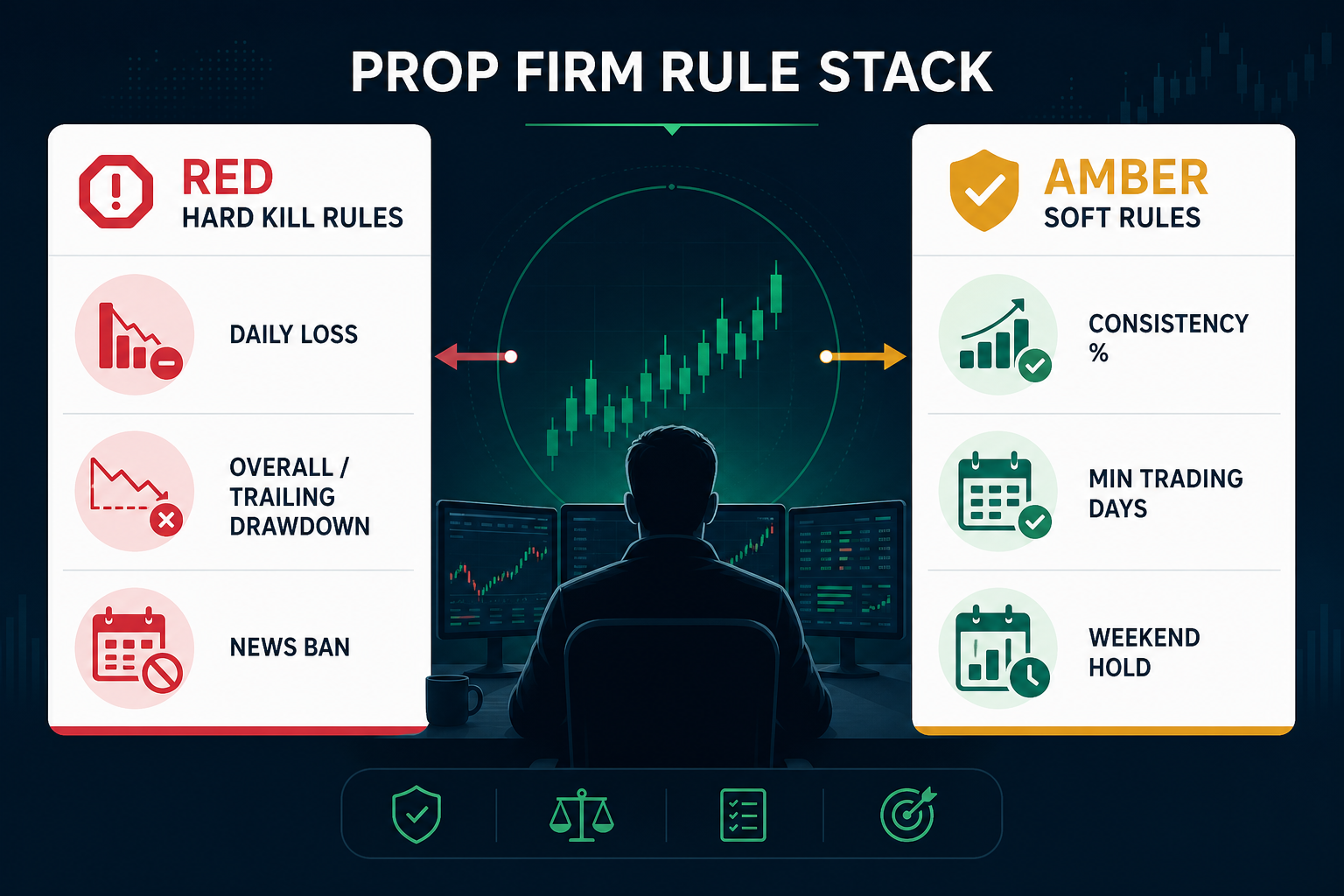
Hard Kill Rules
- • Max daily loss (static or relative)
- • Max overall / trailing drawdown
- • Forbidden instruments or news trading bans
- • Account inactive / inactivity timeout
Soft / Scoring Rules
- • Consistency / best-day profit caps
- • Minimum trading days
- • Lot / exposure soft limits
- • Weekend holding restrictions
Professional habit
Write a one-page "Firm Card" before day one: equity base, daily DD $, overall DD $, trailing yes/no, consistency %, news policy, max trades/day. Tape it next to the platform.
Trailing Equity Drawdown Math
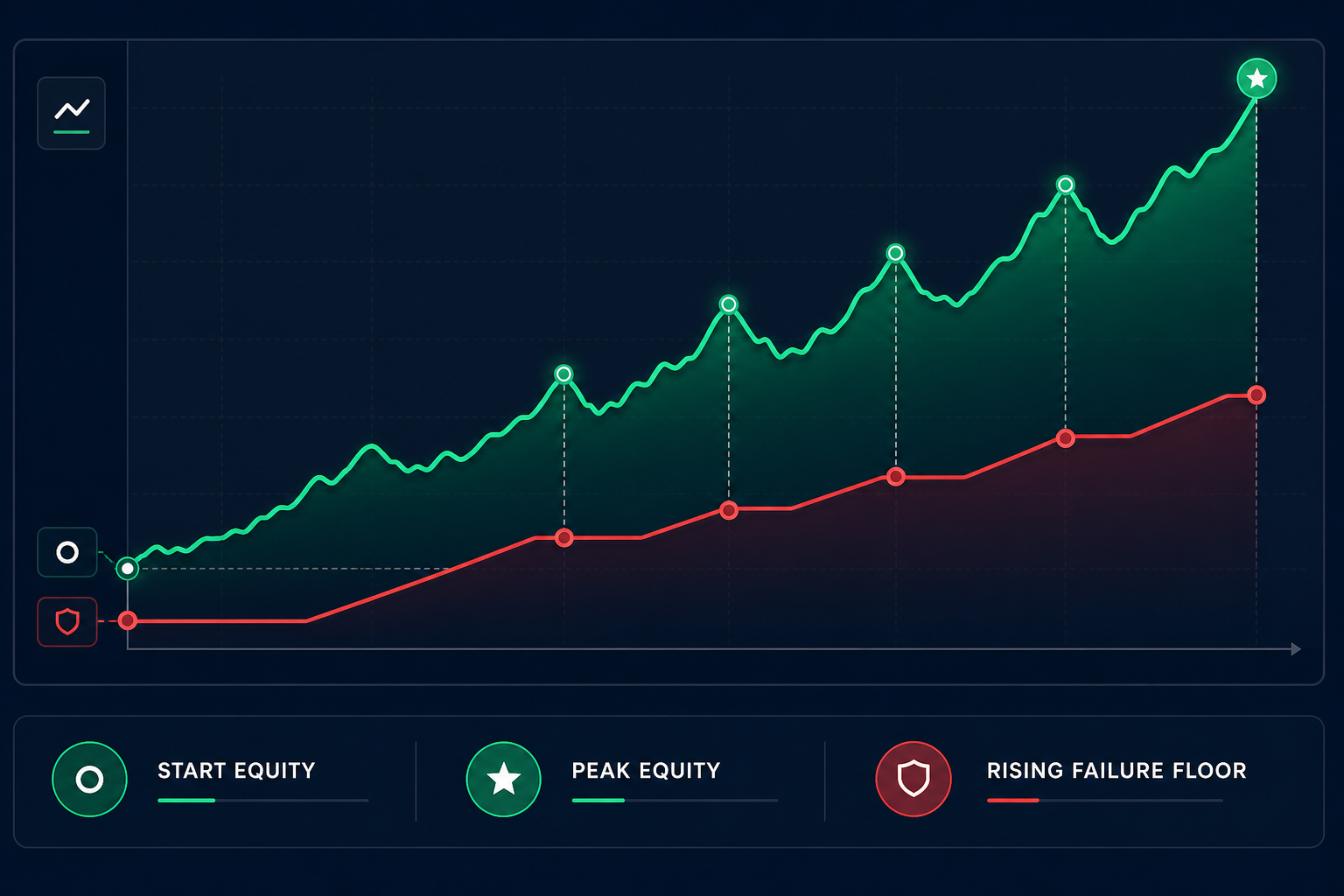
Trailing drawdown (high-water mark) is the silent account killer. As closed equity peaks, your failure line rises with it. Early green days shrink later room for error.
Worked example ($100k evaluation)
Assume: 10% trailing max loss ($10,000 from peak equity). Start $100,000 → breach at $90,000.
After a strong week you close at $108,000. The HWM is now $108k. Breach line lifts to $98,000. Your absolute buffer below the new peak is still $10k, but you can no longer “give back” profits to $90k.
If you then run hot risk sizing as if you still had the original buffer-to-target psychological comfort, one bad London session can both erase gains and push you toward the new floor.
- Recalculate risk % after every new equity high—not once at challenge start.
- Distinguish end-of-day trailing vs intraday equity trail—platforms differ.
Daily Loss Cap Mechanics
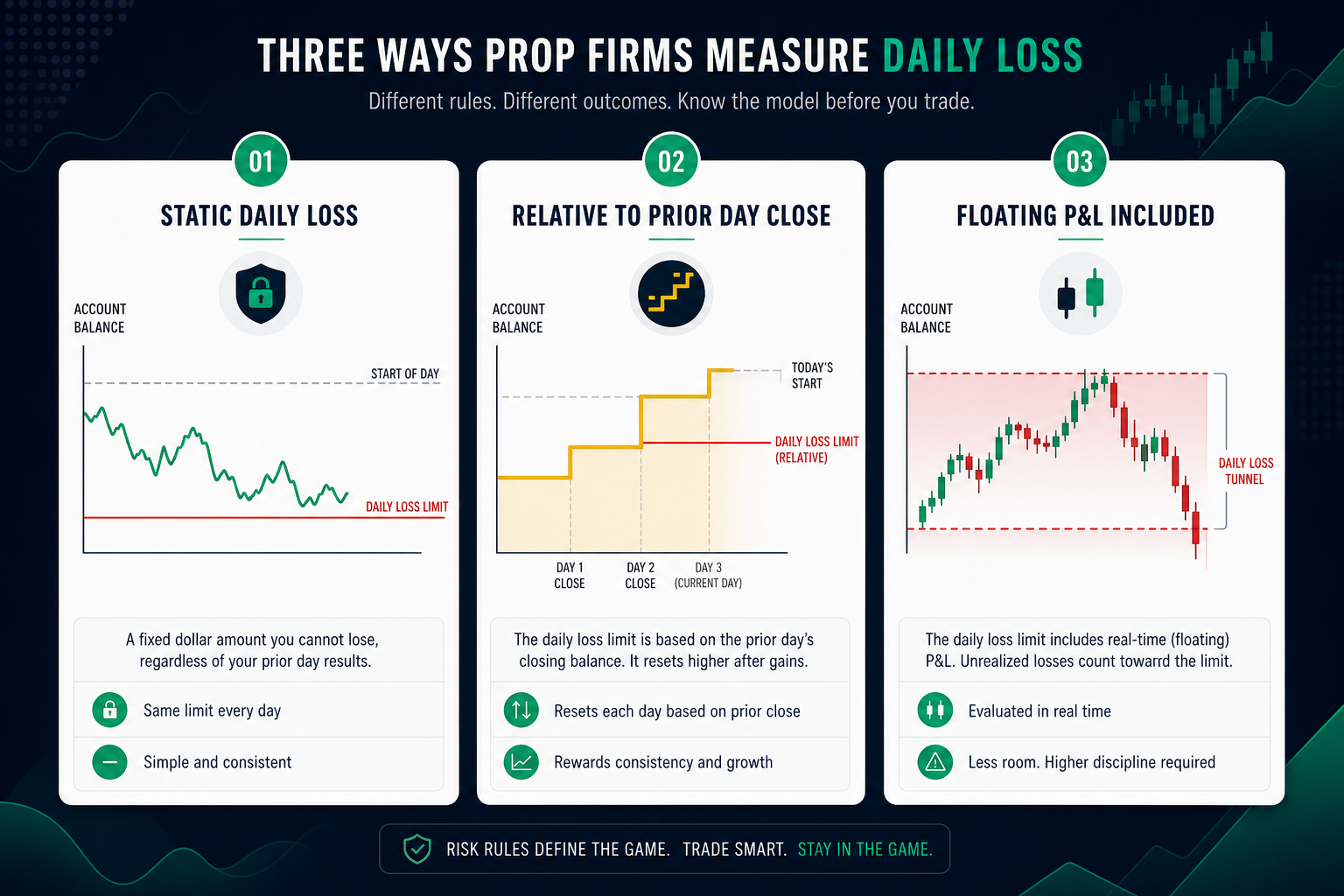
Daily loss is measured differently across firms: some use closed PnL only; others include floating PnL. That distinction decides whether you can hold a drawdown overnight or must flat on a scalp.
Static % of start
Fixed $ limit each day from starting balance. Simple, but unforgiving if you front-load risk after a scratch morning.
Relative to EOD
Daily DD resets from prior day close equity—green days raise the absolute dollar you can risk the next day.
Floating included
Open P&L counts. A spike spike against you mid-trade can auto-fail even if you planned a tighter closed stop.
Operating rule:Treat 40–50% of the daily loss allowance as your "hard stop for the day." The remainder is emergency buffer for slippage and overnight gaps—not more trades.
Consistency & Profit Caps
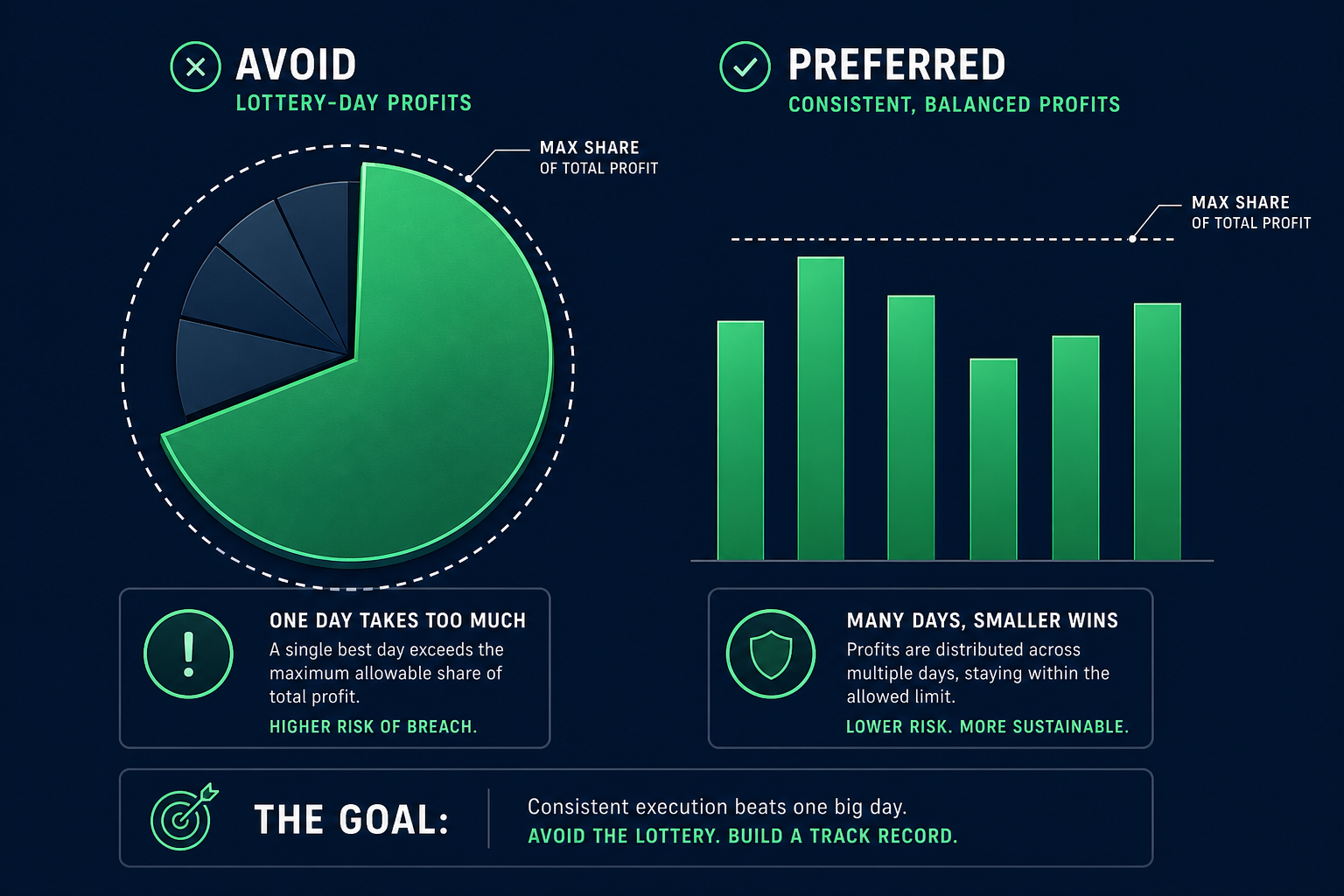
Consistency rules (sometimes labeled best-day / profit share caps) require that no single day dominates total profit. Lottery-day rockets can force you to keep trading just to dilute that day's weight—ironically increasing DD risk.
How to trade under a consistency cap
- • Cap daily profit aspiration (e.g., 1–1.5% of equity)
- • Prefer multiple quality days over one 5% spike
- • After a runaway winner day, reduce size next sessions
- • Track best-day % of total profit daily—not only at the end
Prop-Firm Position Sizing
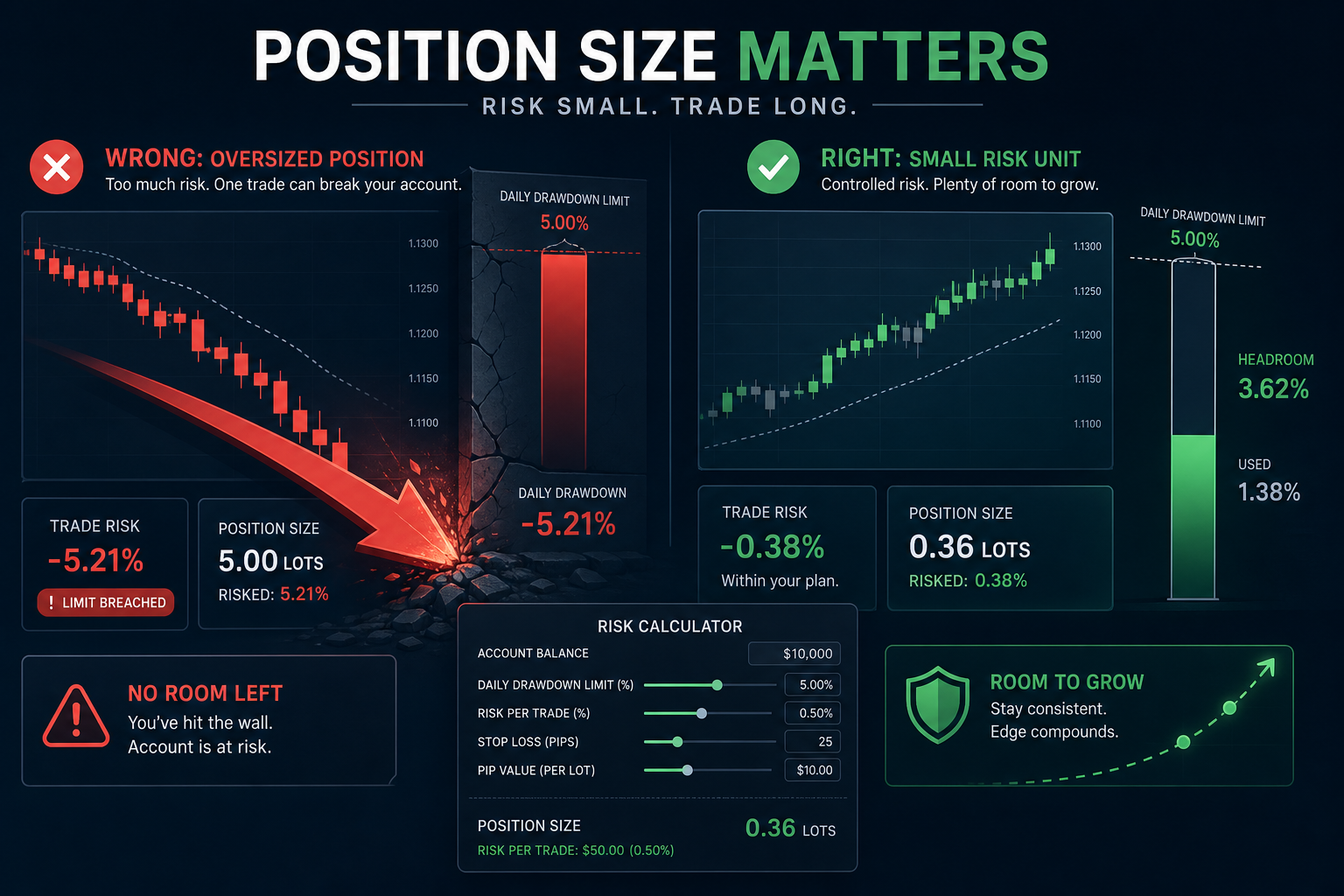
Personal accounts often use 1% risk. Evaluations usually need smaller unit risk because you stack sequential constraints (daily + overall + consistency).
Evaluation phase
- • 0.25–0.50% risk / trade
- • Max 2 trades / day unless A+ confluence
- • Stop day at ~50% of daily DD allowance
- • No martingale stacking after losers
Funded phase
- • Keep evaluation sizing initially
- • Scale only after 2–4 payout cycles
- • Respect trailing DD as permanent contract
- • Payout rhythm > maximal weekly ROI
Use a risk calculator with stop distance in pips and remaining daily headroom in dollars. If headroom is $800 and your planned risk is $1,000, the trade is invalid—even if the setup is A+.
Session & News Filters
Evaluation accounts are destroyed by low-liquidity chop and news spikes more often than by slow bleed. Define a session charter before entries.
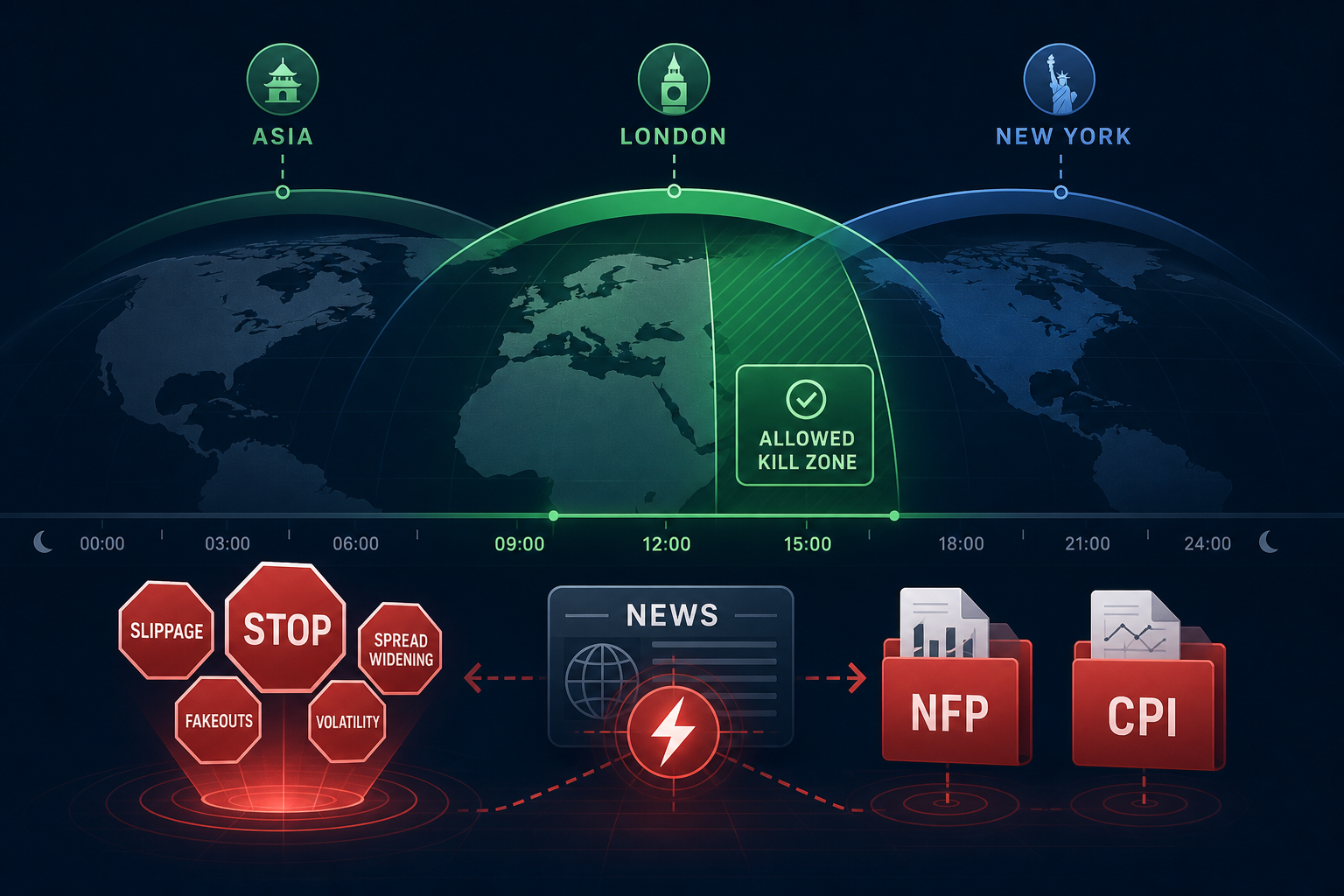
- Prefer London open / New York overlap for majors; avoid dead Asiatic ranges unless your edge is specifically Asian pairs.
- Flat 15–30 minutes before red-folder events unless the firm permits news and you have a written plan.
- For XAUUSD and JPY crosses, widen the definition of "high impact"—spreads can widen unexpectedly.
Signal Playbook for Evaluations
Professional signals with fixed SL/TP can fit challenges—if you filter for rules, not for FOMO. The goal is repeatable risk units that never violate caps.
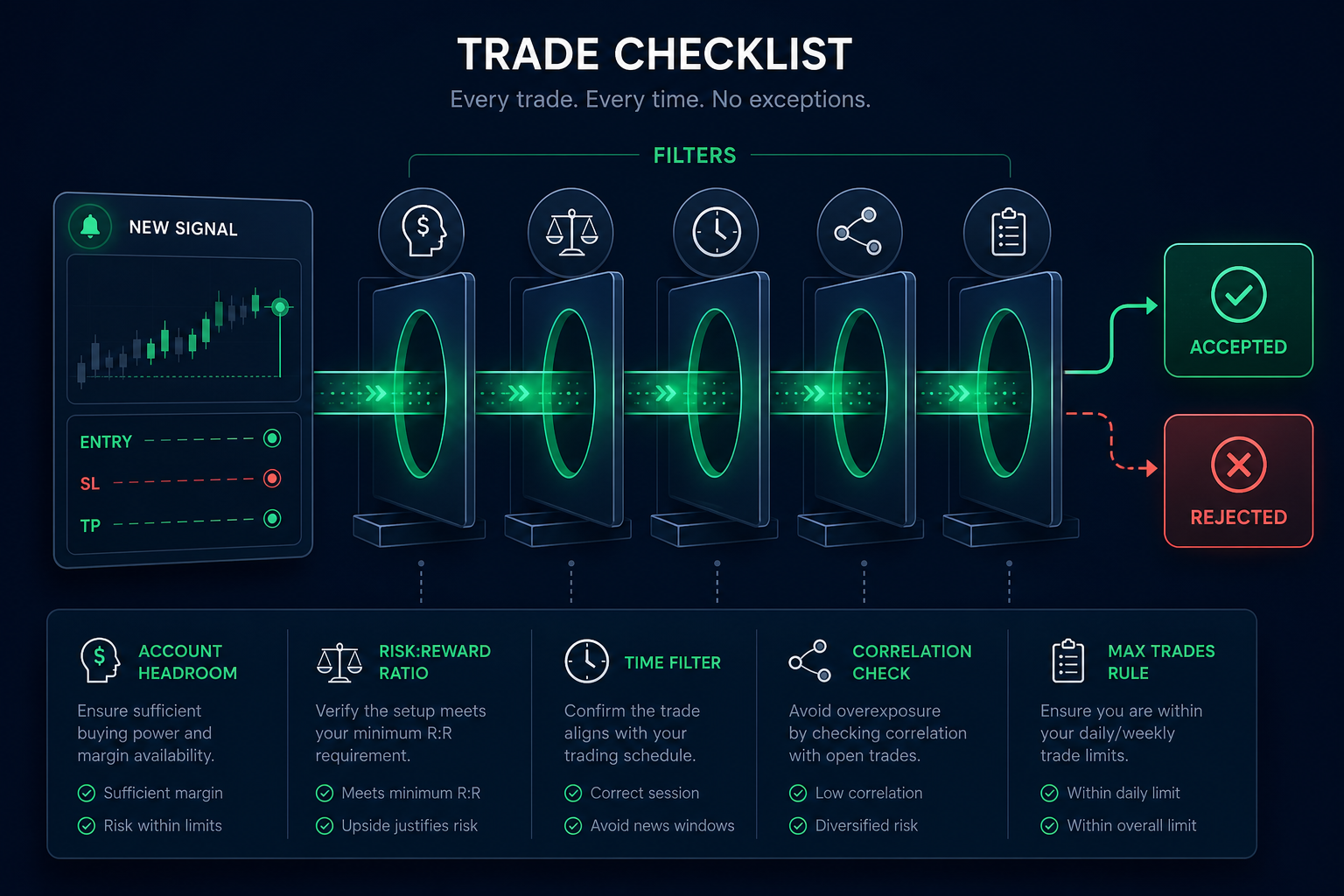
Signal admission checklist
- 1. Risk fit: Planned $ risk ≤ remaining daily headroom × 0.5
- 2. R:R floor: At least ~1:1.5 after realistic spread (gold may differ)
- 3. Session: Signal fires inside your allowed kill window
- 4. Correlation: Do not stack EURUSD + GBPUSD + gold as three full risks
- 5. Count: Soft max 2 opens / day in Phase 1
If you use SignalWavesAI alerts, treat them as setup candidates inside this filter—not automatic market orders. Pair pages such as EUR/USD signals help you study instrument behavior before sizing for a challenge.
Phase 1 → Funded Plan
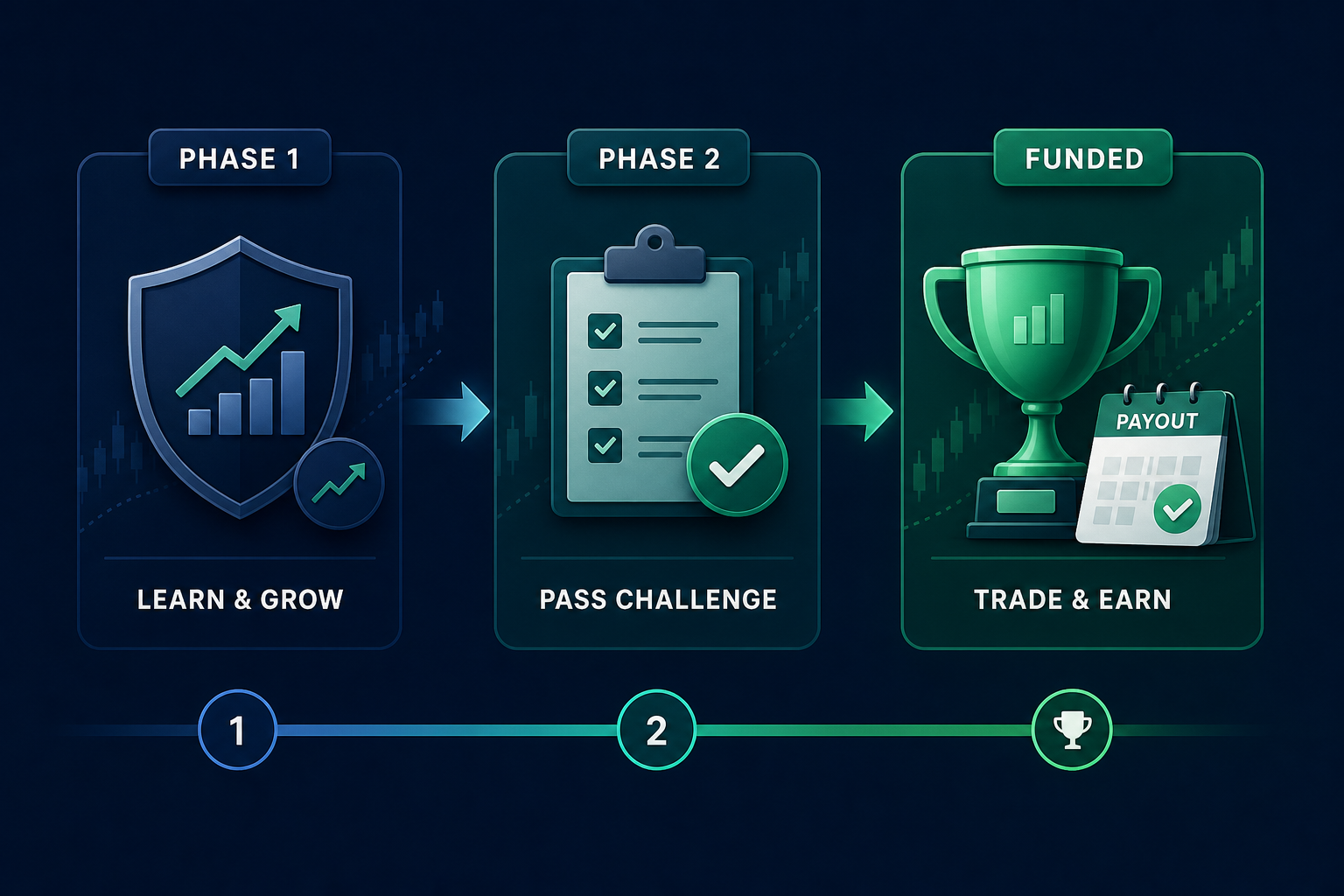
Phase 1 — Survival growth
Hit the profit target with minimal variance. Ignore “make it in three days” folklore. Track buffer daily.
Phase 2 — Proof of process
Same sizing. Do not increase risk because Phase 1 "felt easy." This phase filters undisciplined winners.
Funded — Payout durability
Switch KPI from “pass speed” to “payout sequence.” One reckless week can erase months of evaluation fees and work.
Risk & Psychology Rules
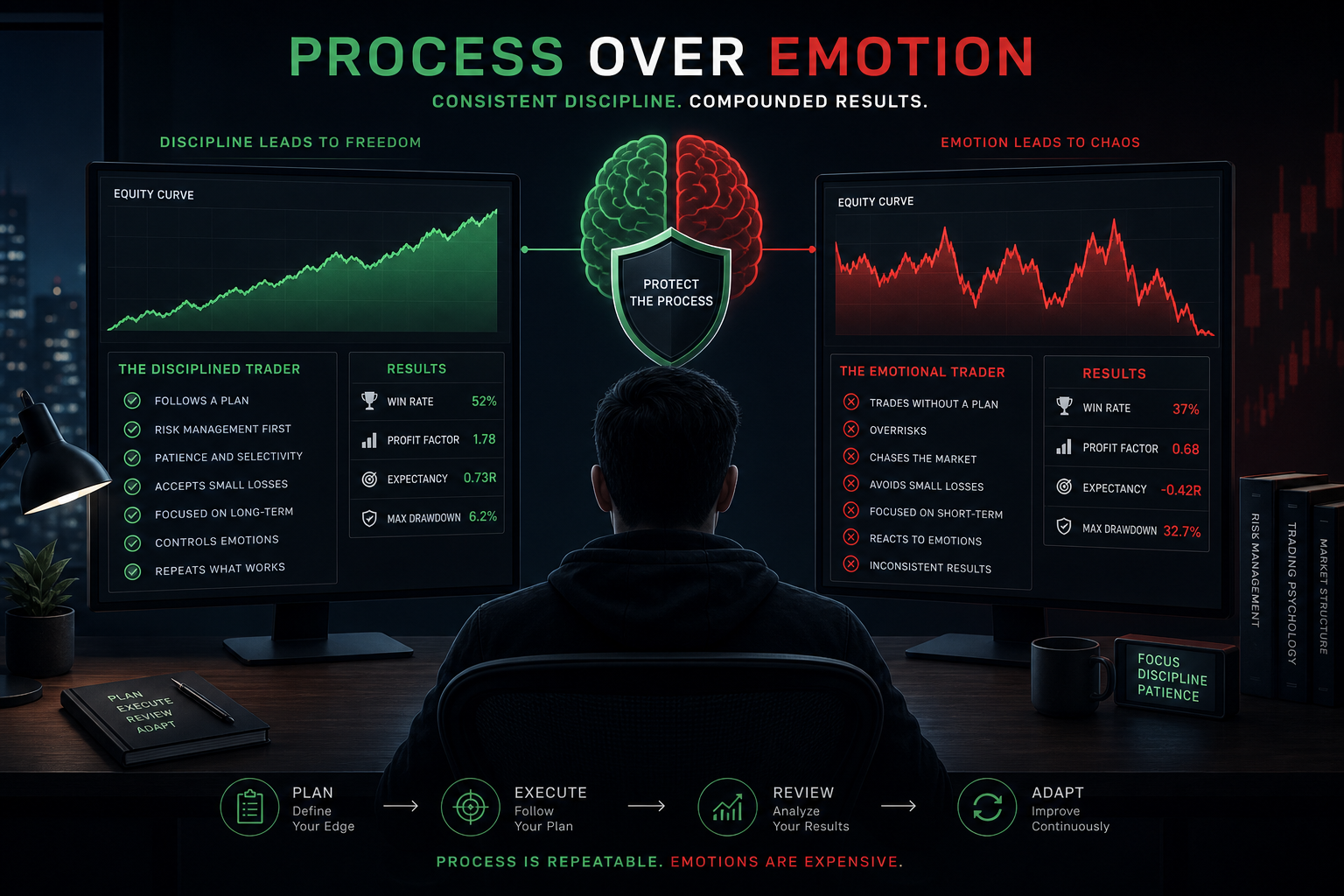
Hard stops
- • 2 losses → done for the day
- • Never move SL farther after entry
- • No adding to losers
- • No "make it back" sessions
Process KPIs
- • % of days within daily DD plan
- • Filter rejection rate (skipped setups)
- • Average R risked vs planned
- • Journal of emotional tags
Challenge Killers
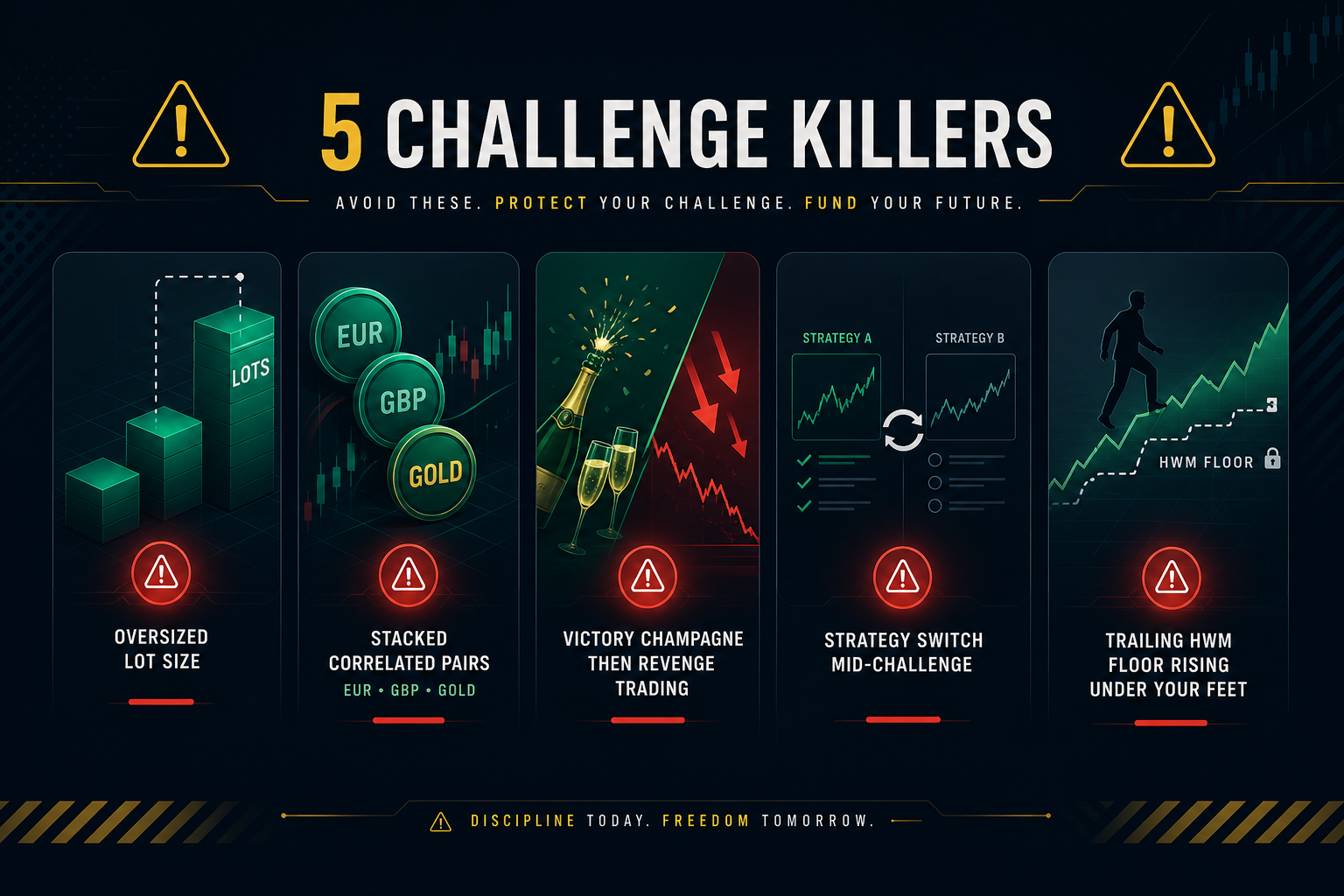
Sizing to stop, ignoring daily DD
Classic pip-based risk blows past daily caps when stops are wide on gold or news.
Stacking correlated pairs
Three “1%” risks on EURUSD, GBPUSD, and XAUUSD can behave like one 2.5–3% risk event.
Victory-day overtrading
After a big green day under consistency rules, more trading can be forced and reckless.
Changing strategy mid-challenge
Switching from signals to gut scalping after two losses destroys process data.
Ignoring trailing HWM
Trading Phase 1 peak equity like a personal account with “play money” profit.
Getting Funded the Hard Way Done Right
Passing in 2026 is less about secret entries and more about contracted risk. Build a Firm Card, size to headroom, filter sessions and news, and treat signals as candidates inside those rules.
Your 5-step launch checklist
- 1Write the Firm Card (DD math + consistency + news).
- 2Set risk at 0.25–0.5% with a daily headroom stop.
- 3Define session windows and max trades.
- 4Apply the signal admission checklist every entry.
- 5Journal breaches that almost happened—not only closed losses.
FAQ
What is the biggest reason traders fail prop firm challenges in 2026?
Most failures are drawdown-rule failures, not “bad strategy.” Daily loss caps and trailing equity drawdowns kill accounts when position size is calibrated to stop distance instead of remaining drawdown headroom.
How should I size risk for a prop firm evaluation?
Size to the tighter of: (1) firm daily loss limit buffer and (2) overall drawdown buffer. A common professional approach is 0.25–0.5% risk per trade during evaluation, with a hard stop after 50–60% of the daily loss allowance is used.
Should I trade news during a prop firm challenge?
Only if the firm explicitly allows it and you have a predefined news protocol. For most evaluations, stay flat into high-impact releases (NFP, CPI, FOMC) because spread expansion can breach daily drawdown faster than a normal stop.
Can forex signals help pass a prop firm challenge?
Signals can help if you filter them through firm rules: session windows, max trades/day, no revenge stacking, and risk sized to drawdown headroom—not signal confidence alone.