
Forex Scalping vs Algorithmic Trading 2025: Complete Comparison Guide
Discover the key differences between scalping and algorithmic trading. Compare profit potential, time commitment, risk management, and choose the strategy that fits your trading style.
Introduction: Scalping vs Algorithmic Trading
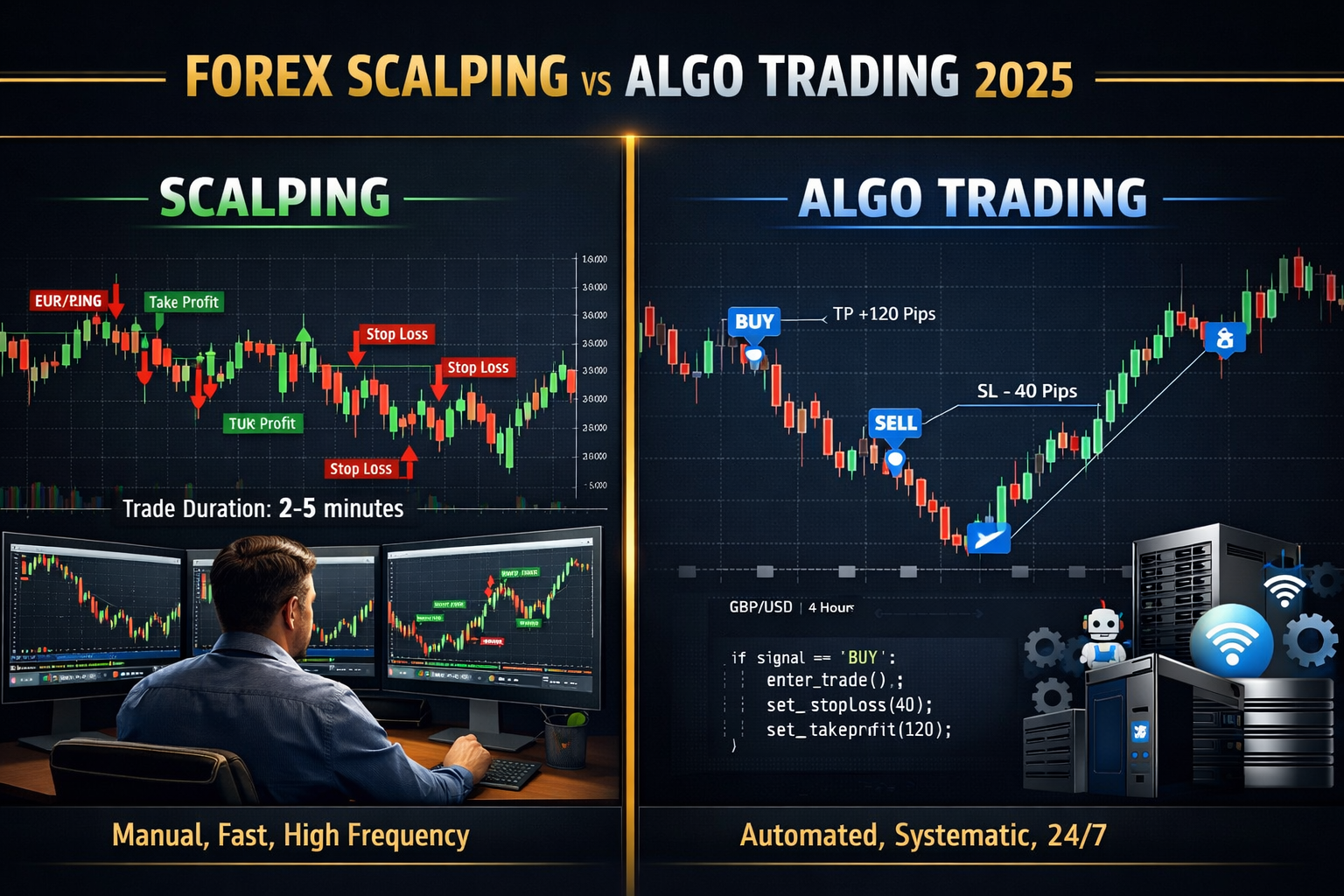
In the world of forex trading, two distinct approaches dominate the landscape: scalping and algorithmic trading. Both strategies offer unique advantages and challenges, but they couldn't be more different in execution, time commitment, and profit potential. Understanding these differences is crucial for any trader looking to optimize their trading approach in 2025.
This comprehensive 2025 guide will help you understand the fundamental differences between these two trading styles, compare their profit potential, risk management approaches, and determine which strategy aligns with your trading goals, lifestyle, and skill set. We'll dive deep into the mechanics, requirements, and real-world performance of each approach.
Whether you're an active trader looking for quick profits or a systematic trader seeking passive income, this comparison will provide the insights you need to make an informed decision. We'll explore everything from capital requirements and learning curves to market conditions and technology needs.
What is Forex Scalping?
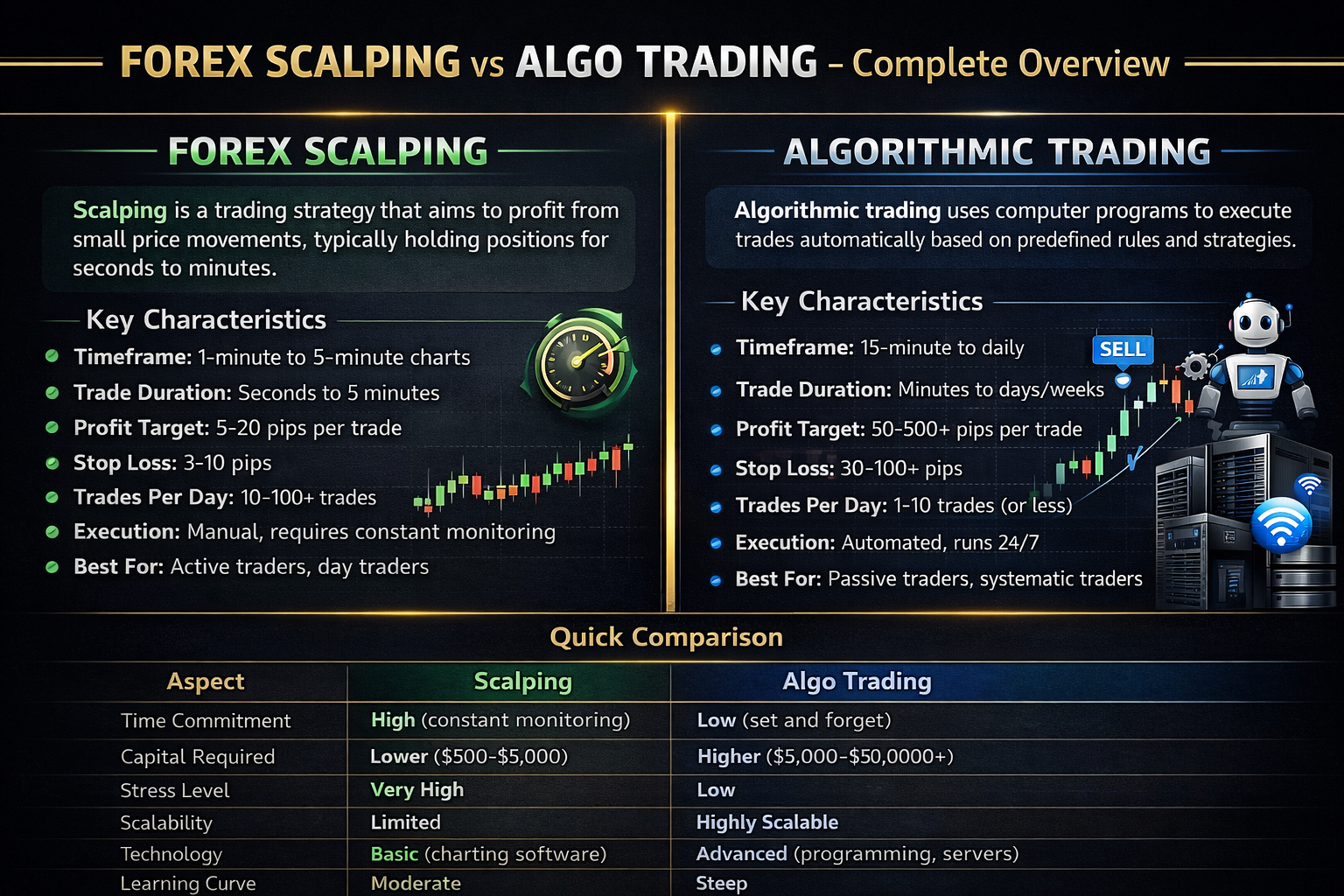
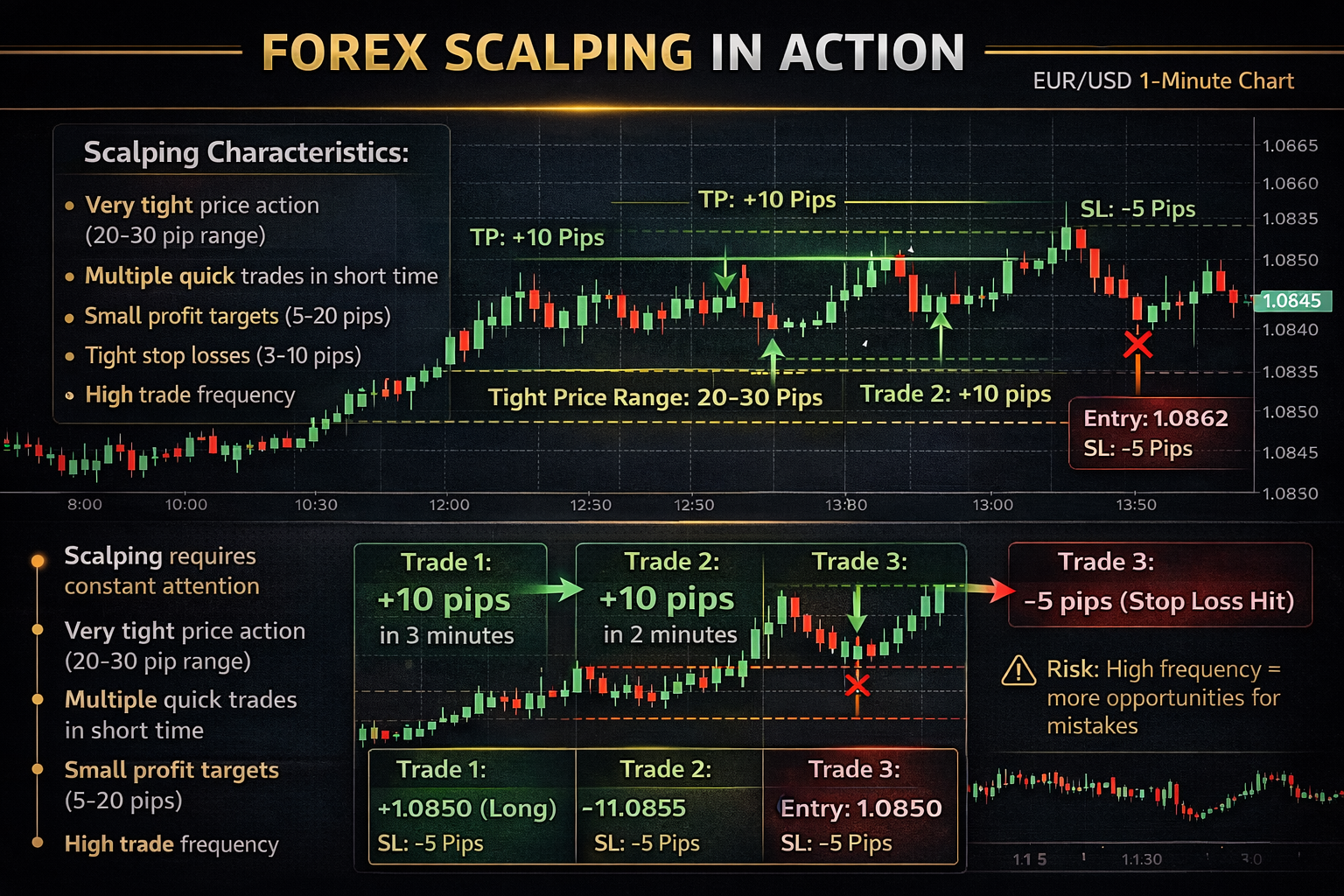
Forex scalping is a high-frequency trading strategy where traders aim to profit from small price movements, typically holding positions for seconds to a few minutes. Scalpers execute numerous trades throughout the day, targeting profits of 5-20 pips per trade. This strategy requires intense focus, quick decision-making, and the ability to monitor markets continuously during active trading sessions.
Scalping is one of the most demanding trading styles, requiring traders to be physically present and mentally alert for extended periods. Unlike swing trading or position trading, scalpers don't hold positions overnight. Instead, they enter and exit trades rapidly, sometimes making dozens of trades in a single session. The goal is to capture small price movements that occur frequently throughout the day, accumulating profits through volume rather than large individual gains.
Key Characteristics of Scalping:
- Timeframes: 1-minute to 5-minute charts exclusively. Scalpers need to see the smallest price movements and react instantly to market micro-structure changes.
- Trade Duration: Seconds to 5 minutes maximum. Most scalping trades are closed within 1-3 minutes, with some lasting only 10-30 seconds. Positions are never held through major news events or overnight.
- Profit Target: 5-20 pips per trade. Scalpers aim for small, consistent profits. A successful scalper might make 20-50 pips per day through multiple trades, but each individual trade targets only a few pips.
- Stop Loss: 3-10 pips (very tight). Risk management is critical in scalping. Since profit targets are small, stop losses must be equally tight to maintain a positive risk-reward ratio. Most scalpers use a 1:1 or 1:1.5 risk-reward ratio.
- Execution: Manual, requires constant monitoring. Scalpers must watch charts continuously, identify setups in real-time, and execute trades immediately. There's no room for hesitation or delayed decision-making.
- Trades Per Day: 10-100+ trades. Active scalpers can execute dozens of trades daily. Some professional scalpers make over 100 trades per day, constantly entering and exiting positions to capture micro-movements.
Scalping requires a specific mindset and skill set. Traders must be able to make split-second decisions, maintain intense focus for hours, and handle the psychological pressure of frequent trading. The strategy works best during high-liquidity periods when spreads are tight and price movements are frequent but small.
Successful scalpers often develop an intuitive feel for market micro-structure, learning to read order flow, identify support and resistance levels on very short timeframes, and recognize patterns that repeat throughout the day. This requires extensive screen time and experience with specific currency pairs.
What is Algorithmic Trading?
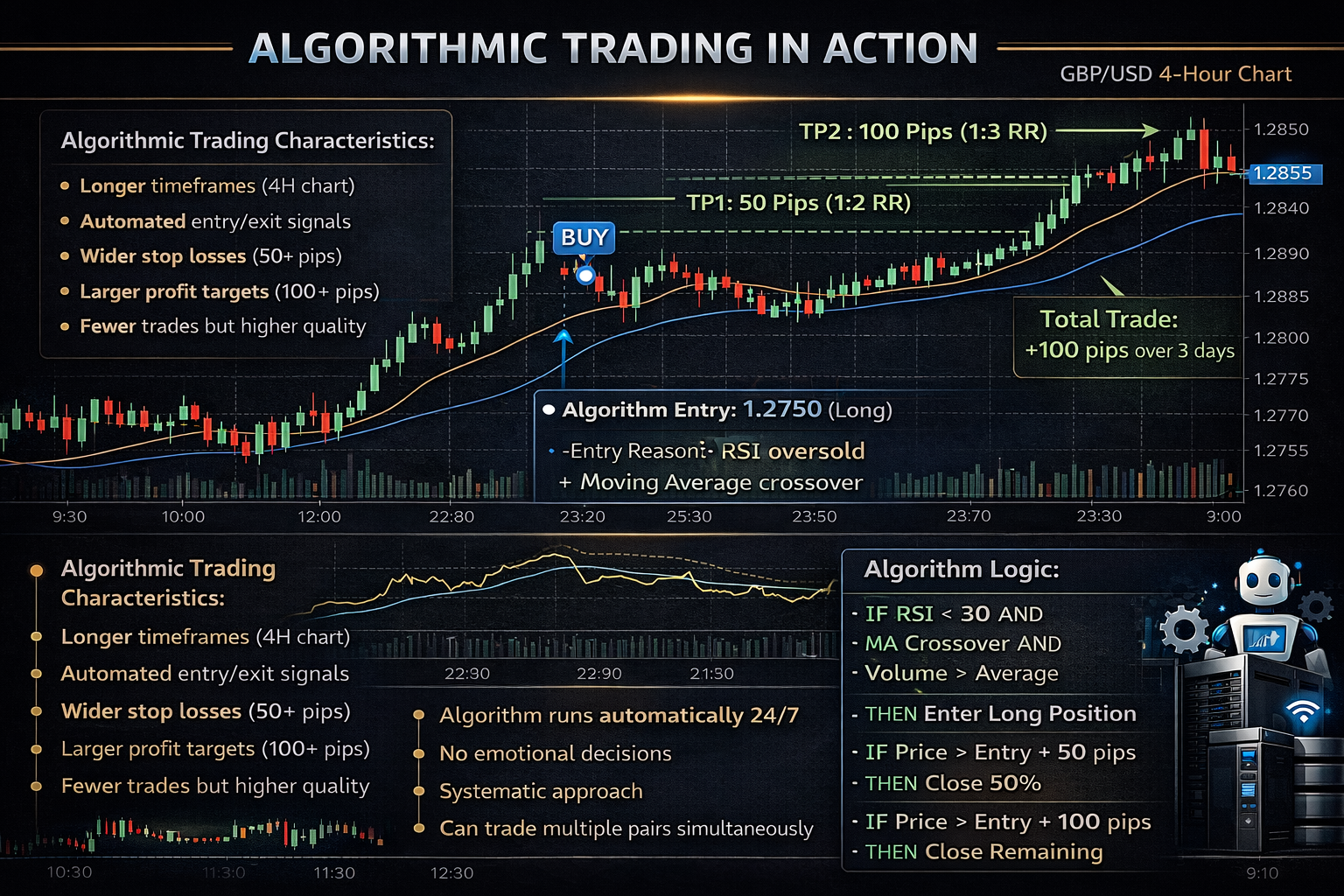
Algorithmic trading (also known as algo trading or automated trading) uses computer programs to execute trades automatically based on predefined rules and strategies. These algorithms analyze market conditions, identify trading opportunities, and execute trades without human intervention, running 24/7 across all market sessions. Unlike manual trading, algorithmic trading removes emotions from the equation and can process vast amounts of data in milliseconds.
Algorithmic trading represents the evolution of trading into the digital age. These systems can monitor multiple currency pairs simultaneously, analyze complex technical indicators, and execute trades at optimal prices faster than any human trader could. The algorithms are based on mathematical models, statistical analysis, and predefined rules that have been backtested on historical data to ensure profitability.
Key Characteristics of Algorithmic Trading:
- Timeframes: 15-minute to daily charts. Algo trading systems work best on longer timeframes where market noise is reduced and trends are more reliable. Most successful algorithms use 1-hour, 4-hour, or daily charts.
- Trade Duration: Minutes to days/weeks. Algorithmic trades can last from a few minutes to several weeks, depending on the strategy. Position trading algorithms may hold trades for days or weeks, while swing trading algorithms typically hold for hours to days.
- Profit Target: 50-500+ pips per trade. Algo trading targets larger moves, as the systems don't need to monitor constantly. A single successful algorithmic trade can generate profits equivalent to dozens of scalping trades.
- Stop Loss: 30-100+ pips (wider stops). Since algorithmic trading targets larger moves, stop losses are proportionally wider. This allows trades room to breathe and avoids premature exits due to normal market volatility.
- Execution: Automated, runs 24/7. Once deployed, algorithmic trading systems operate continuously, monitoring markets, analyzing conditions, and executing trades without human intervention. They can trade during all market sessions, including times when human traders are sleeping.
- Trades Per Day: 1-10 trades (or less). Algorithmic systems are selective, only entering trades when all conditions are met. High-quality algorithms may generate only a few trades per week, but each trade has a higher probability of success.
Algorithmic trading requires significant upfront investment in development, testing, and infrastructure. Traders need programming skills or must hire developers, invest in backtesting software, and potentially pay for market data feeds and VPS hosting. However, once operational, these systems can generate passive income with minimal ongoing time commitment.
The key advantage of algorithmic trading is its ability to maintain discipline and consistency. Algorithms never deviate from their rules due to fear, greed, or emotional impulses. They execute trades based purely on data and predefined logic, which can lead to more consistent long-term performance than manual trading.
Time Commitment Comparison
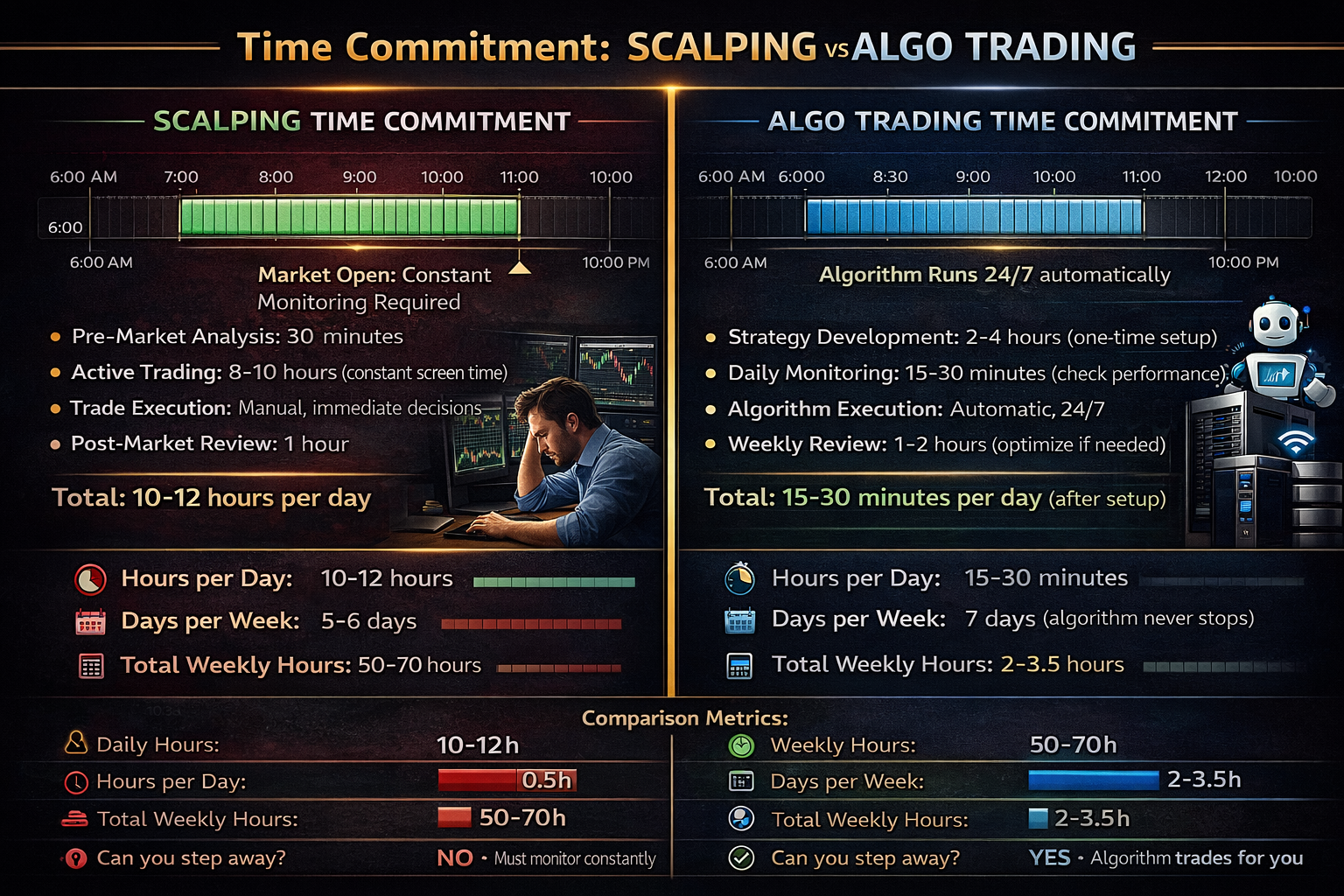
One of the most significant differences between scalping and algo trading is the time commitment required. Understanding this difference is crucial for choosing the right strategy for your lifestyle, career, and personal circumstances.
Scalping Time Requirements
Scalping is an extremely time-intensive strategy. Professional scalpers typically spend 8-12 hours per day actively monitoring markets and executing trades. This includes:
- Pre-market preparation (1-2 hours): Reviewing overnight news, analyzing economic calendars, identifying key support and resistance levels, and preparing a trading plan for the day.
- Active trading sessions (6-8 hours): Constant screen monitoring during London, New York, and Asian session overlaps when volatility and liquidity are highest. Scalpers must remain focused and alert throughout.
- Post-market analysis (1-2 hours): Reviewing trades, analyzing performance, identifying mistakes, and planning for the next trading day.
Scalping is essentially a full-time job. It's nearly impossible to scalp effectively while maintaining another career or significant personal commitments. The strategy requires undivided attention during trading hours, making it unsuitable for part-time traders or those with busy schedules.
Algorithmic Trading Time Requirements
Algorithmic trading offers a completely different time commitment profile. After the initial setup phase, algo trading requires 15-30 minutes per day for monitoring and maintenance:
- Initial development (100-200 hours): Learning programming, developing algorithms, backtesting strategies, and setting up infrastructure. This is a one-time investment spread over 3-6 months.
- Daily monitoring (15-30 minutes): Quick check of system status, review of overnight trades, monitoring for any errors or issues, and ensuring systems are running correctly.
- Weekly maintenance (1-2 hours): Performance review, optimization adjustments, updating market data feeds, and ensuring all systems are functioning properly.
- Ongoing optimization (5-10 hours/month): Fine-tuning algorithms based on performance, adapting to changing market conditions, and implementing improvements.
Once operational, algorithmic trading is truly passive. The systems run 24/7 without constant supervision, allowing traders to maintain full-time careers, travel, or pursue other interests while their algorithms generate income in the background.
Profit Potential Analysis
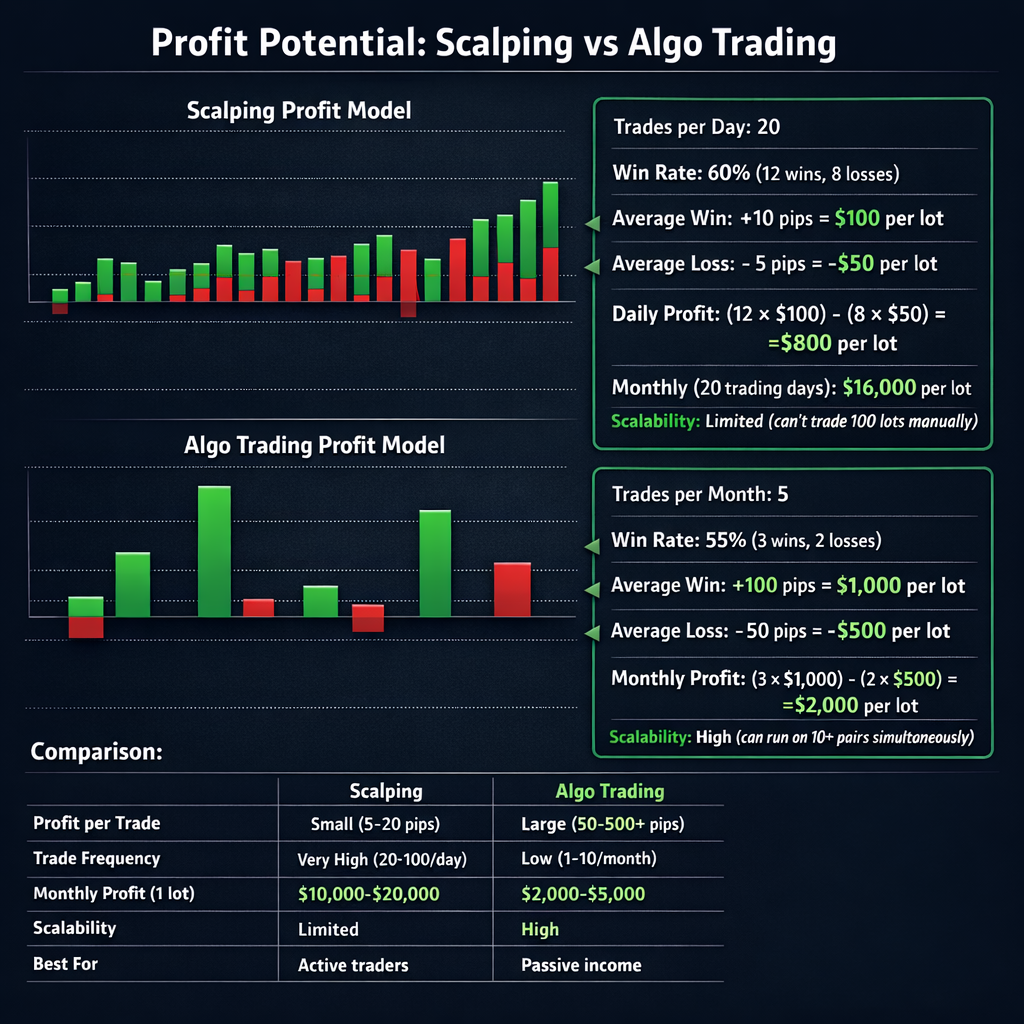
Both strategies can be profitable, but they generate returns in fundamentally different ways. Understanding the profit potential and realistic expectations for each approach is essential for making an informed decision.
Scalping Profit Potential
Scalping offers the highest potential monthly returns of any trading style, but with significant caveats. Successful professional scalpers can achieve 10-30% monthly returns on their trading capital, but this requires:
- Extensive experience and skill development (6-12 months minimum)
- Perfect execution and emotional discipline
- Optimal market conditions (high liquidity, tight spreads)
- Sufficient capital to overcome transaction costs
- Consistent daily trading without significant drawdowns
However, scalping profits are highly variable. A scalper might make 5% one week and lose 3% the next. The high frequency of trades means that small mistakes compound quickly. Transaction costs (spreads and commissions) can eat into profits significantly, especially for traders with smaller accounts.
Realistic expectations: Beginner scalpers often lose money for the first 6-12 months. Intermediate scalpers might achieve 5-15% monthly returns. Only highly skilled, experienced scalpers consistently achieve 20%+ monthly returns, and even they experience significant drawdown periods.
Algorithmic Trading Profit Potential
Algorithmic trading offers more consistent but generally lower monthly returns compared to scalping. Well-designed algorithms typically generate 5-15% monthly returns with lower volatility and drawdowns:
- Consistent performance without emotional interference
- Lower transaction costs due to fewer trades
- Ability to trade multiple pairs and strategies simultaneously
- 24/7 operation capturing opportunities across all sessions
- Scalable systems that can handle larger capital
The key advantage of algorithmic trading is consistency and scalability. While individual monthly returns might be lower than peak scalping returns, algorithms maintain performance over longer periods. A 10% monthly return compounded over a year is more valuable than alternating 30% and -10% months.
Realistic expectations: After the initial development period, algorithmic traders can expect 5-12% monthly returns with proper risk management. The systems are scalable, meaning you can increase capital without proportionally increasing time commitment, making it ideal for building long-term wealth.
Risk Management Comparison
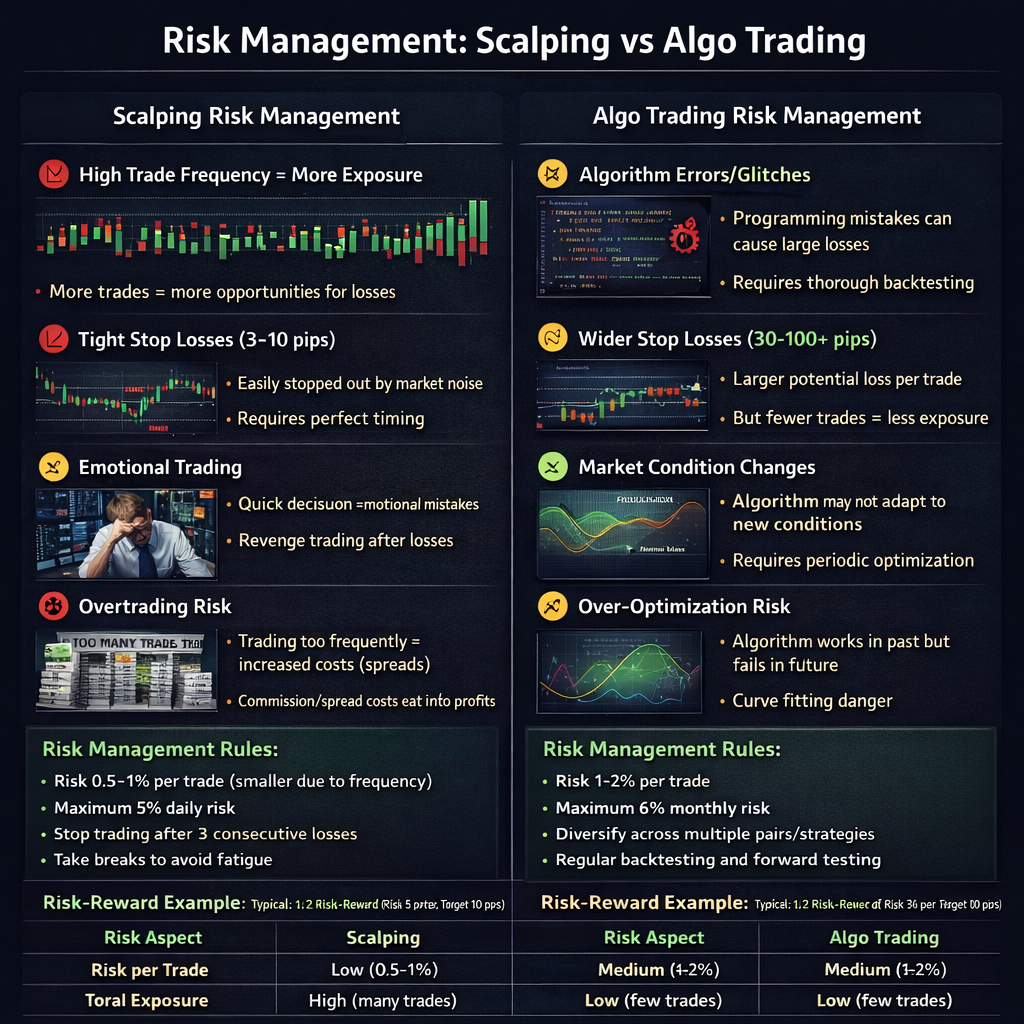
Effective risk management is essential for both strategies, but they face different types of risks and require different approaches. Understanding these differences helps you protect your capital and maintain long-term profitability.
Scalping Risk Management
Scalping presents unique risk management challenges due to the high frequency of trades and tight stop losses:
- Emotional Risk: The high frequency of trades increases emotional pressure. Scalpers must resist the urge to revenge trade after losses, overtrade during winning streaks, or deviate from their strategy due to fear or greed.
- Slippage Risk: Tight stop losses mean that even small slippage can turn a winning trade into a loss. During volatile periods or low liquidity, execution prices can differ significantly from expected prices.
- Spread Risk: Transaction costs (spreads) are proportionally larger for scalping due to small profit targets. A 2-pip spread on a 5-pip target means 40% of potential profit goes to the broker.
- Overtrading Risk: The temptation to trade constantly can lead to entering low-quality setups. Scalpers must maintain discipline and only trade when conditions are optimal.
- Fatigue Risk: Extended screen time leads to mental fatigue, reducing decision-making quality. Tired scalpers make more mistakes, leading to losses.
Best practices: Risk only 1-2% per trade, use strict daily loss limits (stop trading after 3-5 consecutive losses), take regular breaks to maintain mental clarity, and never risk more than 5-10% of capital in a single day regardless of performance.
Algorithmic Trading Risk Management
Algorithmic trading offers superior risk management capabilities due to systematic execution and emotion-free decision-making:
- Emotion-Free Execution: Algorithms never deviate from risk management rules due to emotions. They execute stop losses and take profits exactly as programmed, eliminating emotional trading mistakes.
- Backtested Risk Parameters: Algorithms are tested on historical data, allowing traders to understand maximum drawdowns, win rates, and risk-reward ratios before risking real capital.
- Position Sizing Algorithms: Advanced algorithms can adjust position sizes based on volatility, account equity, and recent performance, optimizing risk dynamically.
- Correlation Management: Algorithms can monitor and limit exposure across correlated currency pairs, preventing over-concentration of risk.
- Circuit Breakers: Built-in safety mechanisms can automatically pause trading during unusual market conditions, protecting capital during black swan events.
Best practices: Risk 1-2% per trade, implement maximum daily drawdown limits (stop trading if account drops 5-10% in a day), diversify across multiple algorithms and currency pairs, regularly review and optimize risk parameters, and maintain adequate capital reserves for drawdown periods.
Technology & Tools Required
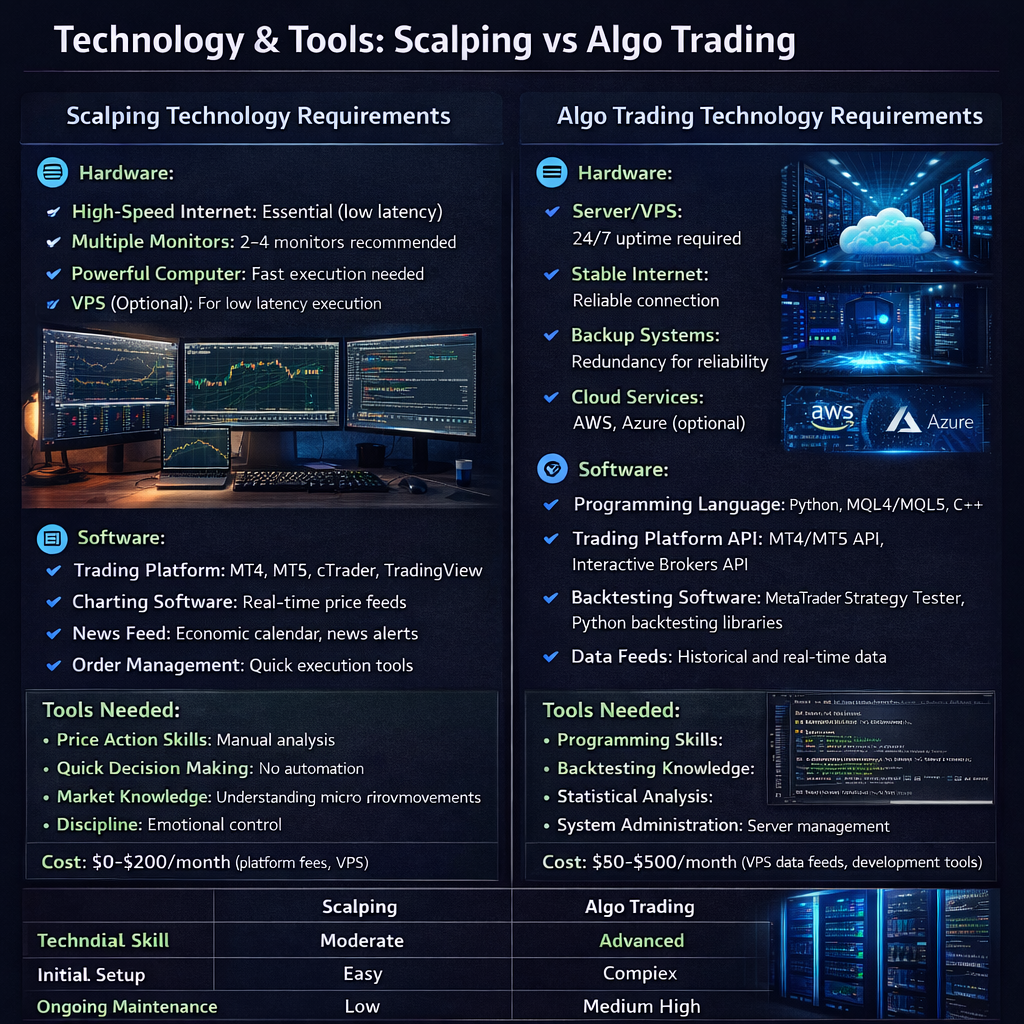
The technology requirements for scalping and algo trading are vastly different. Understanding these requirements helps you prepare for the strategy you choose and budget accordingly.
Scalping Technology Requirements
Scalping requires relatively simple technology, but with specific performance requirements:
- Trading Platform: Professional-grade platform (MetaTrader 4/5, cTrader, or proprietary broker platforms) with fast execution and low latency. Execution speed is critical - even 100ms delay can mean the difference between profit and loss.
- Internet Connection: Ultra-low latency connection (fiber optic preferred) with backup connection. Latency under 10ms to broker servers is ideal. Many professional scalpers use dedicated lines or co-locate servers near broker data centers.
- Hardware: High-performance computer with multiple monitors (3-6 screens) to monitor multiple pairs simultaneously. Fast processor and sufficient RAM to handle multiple chart windows and indicators without lag.
- Market Data: Real-time price feeds, Level II data (order book), and economic calendar. Some scalpers pay for premium data feeds that provide faster price updates than standard feeds.
- Cost: $500-$2,000 initial setup, $100-$300/month for data feeds and platform subscriptions.
Algorithmic Trading Technology Requirements
Algorithmic trading requires more sophisticated technology and infrastructure:
- Programming Skills/Developer: Knowledge of Python, MQL4/MQL5, C++, or similar languages. Alternatively, hiring a developer costs $50-$150/hour. Learning programming takes 3-6 months of dedicated study.
- Backtesting Platform: Software like MetaTrader Strategy Tester, TradingView, or custom Python backtesting frameworks (Backtrader, Zipline). Essential for testing strategies before risking real capital.
- VPS Hosting: Virtual Private Server for 24/7 operation. Costs $20-$100/month depending on specifications. Ensures algorithms run continuously without interruption.
- Market Data API: Access to historical and real-time market data through APIs (often $50-$200/month). Required for backtesting and live trading.
- Monitoring Tools: Dashboard software to monitor algorithm performance, alerts for errors, and performance analytics. Can be custom-built or purchased.
- Cost: $1,000-$5,000 initial development, $100-$400/month for hosting, data, and maintenance.
Best Market Conditions
Different market conditions favor different strategies. Understanding when each approach works best helps optimize your trading performance and avoid trading during unfavorable conditions.
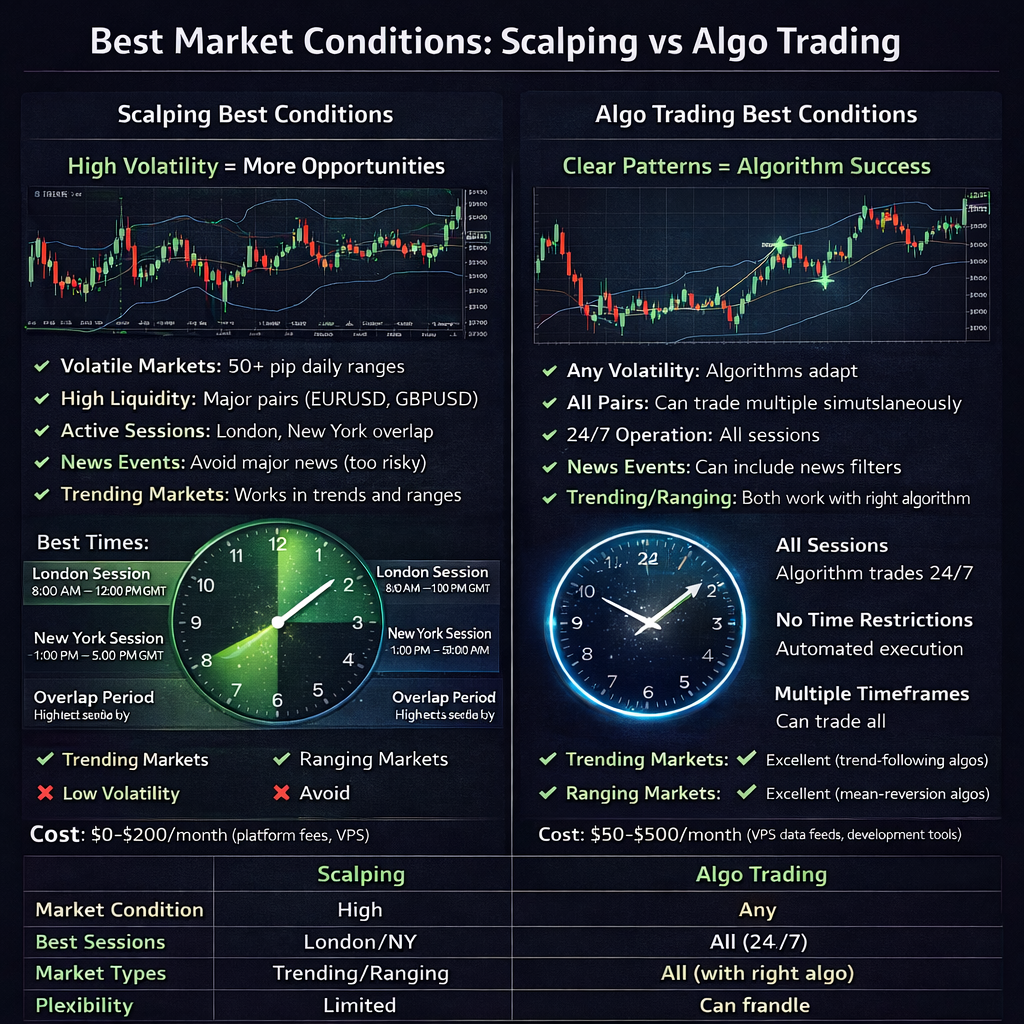
Optimal Scalping Conditions
Scalping thrives in specific market conditions that provide frequent, small price movements:
- High Liquidity Periods: London-New York overlap (8:00 AM - 12:00 PM EST) provides the best conditions. High trading volume ensures tight spreads and minimal slippage.
- Tight Spreads: Major pairs (EUR/USD, GBP/USD, USD/JPY) during active sessions typically have 1-2 pip spreads, making scalping profitable. Avoid exotic pairs with wide spreads.
- Moderate Volatility: Enough movement to capture 5-20 pips, but not so volatile that stop losses are frequently hit. Avoid trading during major news events.
- Clear Trends or Ranges: Scalpers prefer markets with clear direction or well-defined ranges. Choppy, directionless markets are difficult to scalp profitably.
- Avoid: Major news events, low liquidity periods (Asian session for most pairs), and high-impact economic releases that cause unpredictable volatility.
Optimal Algorithmic Trading Conditions
Algorithmic trading can adapt to various market conditions, but performs best in:
- Trending Markets: Algorithms excel at identifying and riding trends. Trend-following algorithms perform best during sustained directional moves.
- Range-Bound Markets: Mean-reversion algorithms profit from markets that oscillate between support and resistance levels.
- All Market Sessions: Unlike scalping, algorithms can trade effectively during Asian, European, and American sessions, capturing opportunities 24/7.
- Multiple Timeframes: Algorithms can simultaneously trade different strategies on different timeframes, adapting to various market conditions.
- News Events: Some algorithms are specifically designed to trade news events, while others automatically pause during high-impact releases to avoid volatility.
The key advantage of algorithmic trading is its ability to trade continuously and adapt to changing conditions. Well-designed algorithms can maintain profitability across different market regimes, while scalping is limited to optimal conditions during specific hours.
Capital Requirements
The capital requirements for each strategy differ significantly. Understanding these requirements helps you plan your trading journey and set realistic expectations.
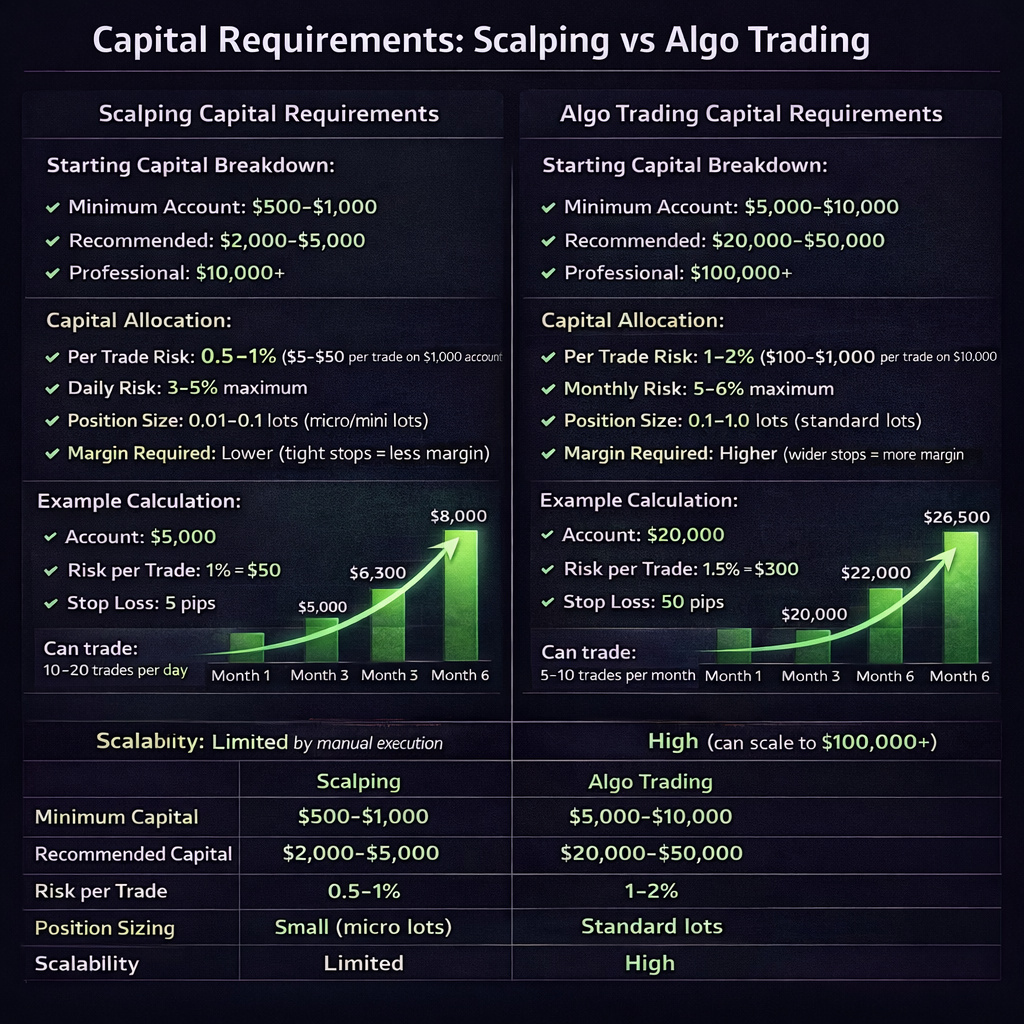
Scalping Capital Requirements
Scalping requires lower initial capital but has specific requirements:
- Minimum Capital: $500-$1,000 to start, but $2,000-$5,000 is recommended. This allows for proper position sizing and risk management while overcoming transaction costs.
- Position Sizing: Scalpers typically risk 1-2% per trade. With a $2,000 account, this means $20-$40 risk per trade. Position sizes are small (0.01-0.05 lots) to maintain tight stop losses.
- Transaction Costs: Spreads and commissions are proportionally larger for scalping. A 2-pip spread on a 5-pip target means 40% of profit goes to costs. Larger accounts can negotiate better spreads.
- Capital Efficiency: Scalping requires active capital that's constantly in use. You can't scale significantly without proportionally increasing time commitment.
- Growth Potential: Scalping profits are limited by time and attention. You can't easily scale from $5,000 to $50,000 without dramatically increasing trading hours.
Algorithmic Trading Capital Requirements
Algorithmic trading requires higher initial capital but offers better scalability:
- Minimum Capital: $5,000-$10,000 minimum, with $20,000-$50,000 recommended. This allows for proper diversification across multiple algorithms and currency pairs.
- Position Sizing: Algorithms use standard position sizes (0.1-1.0 lots) with wider stops. A $20,000 account can comfortably risk 1-2% ($200-$400) per trade.
- Transaction Costs: Lower relative costs due to fewer trades. A 2-pip spread on a 100-pip target is only 2% of profit, making transaction costs negligible.
- Capital Efficiency: Algorithms can trade multiple pairs simultaneously without additional time. Capital can be allocated across different strategies for diversification.
- Growth Potential: Highly scalable. Once an algorithm is proven, you can increase capital from $20,000 to $200,000 with minimal additional time commitment. The algorithm handles the increased volume automatically.
Key Insight: Scalping is more accessible to traders with limited capital, but growth is constrained by time. Algorithmic trading requires more capital upfront but offers unlimited scalability once systems are operational.
Learning Curve Comparison
The learning curve for scalping and algo trading varies significantly. Understanding the time and skills required helps set realistic expectations and plan your trading education journey.
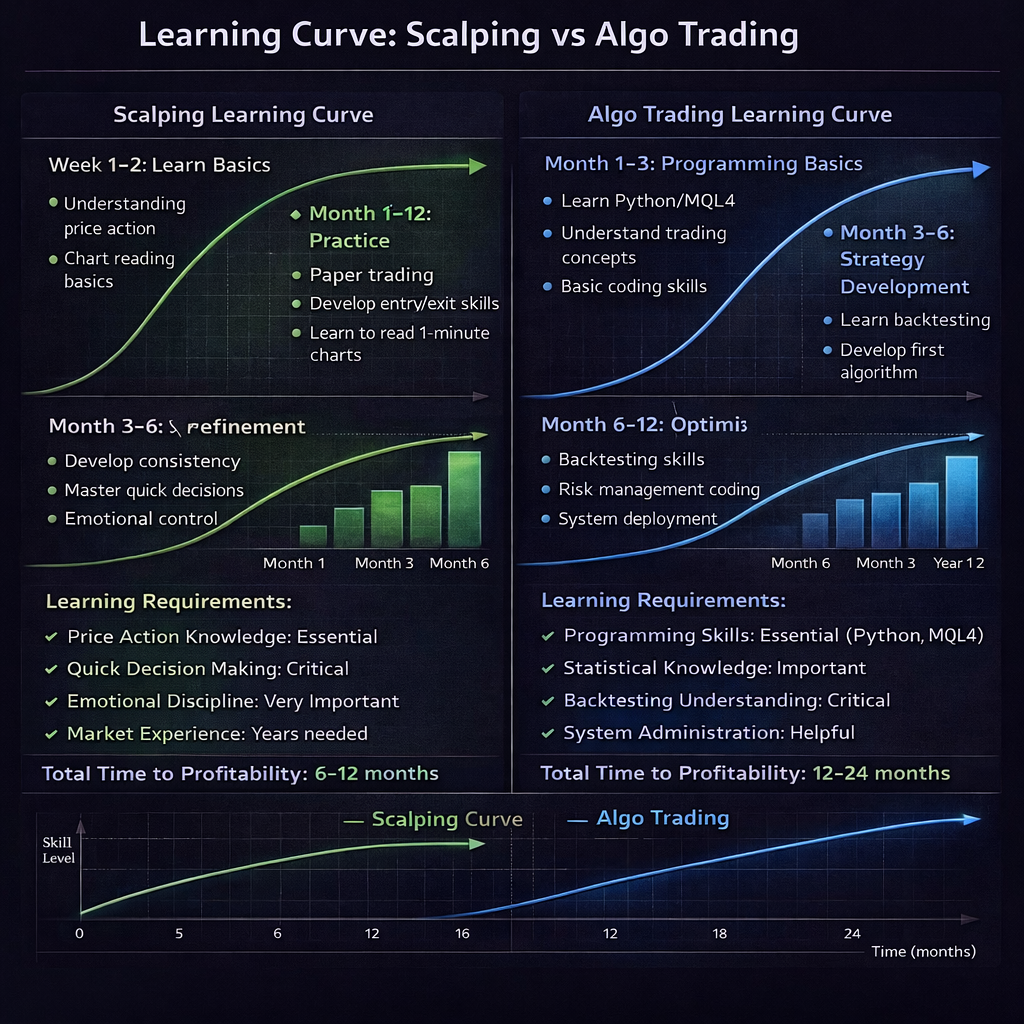
Scalping Learning Curve
Scalping has a moderate learning curve (6-12 months) but requires intense practice:
- Months 1-3: Learn basic technical analysis, understand order flow, practice on demo accounts. Focus on reading 1-minute and 5-minute charts, identifying support/resistance, and understanding spread dynamics.
- Months 4-6: Develop entry and exit strategies, practice risk management, learn to read market micro-structure. Most traders lose money during this period as they learn through experience.
- Months 7-12: Refine strategies, develop emotional discipline, achieve consistent execution. Begin to see consistent profitability, though results may still be variable.
- Skills Required: Quick decision-making, emotional control, pattern recognition, understanding of market microstructure, ability to maintain focus for extended periods.
- Time Investment: 4-8 hours daily of practice and live trading. The learning curve is steep because you must learn while actively trading, which means real losses during the learning process.
Algorithmic Trading Learning Curve
Algorithmic trading has a steeper learning curve (12-24 months) but offers passive income once mastered:
- Months 1-6: Learn programming (Python, MQL4/MQL5, or C++), understand algorithmic trading concepts, learn backtesting methodologies. This phase requires significant study time but minimal capital risk.
- Months 7-12: Develop first algorithms, learn backtesting, understand optimization and overfitting risks. Begin paper trading algorithms to validate strategies without risking capital.
- Months 13-18: Deploy algorithms with small capital, monitor performance, learn to optimize and adapt strategies. This phase involves real capital but with careful risk management.
- Months 19-24: Scale successful algorithms, develop multiple strategies, achieve consistent passive income. By this point, systems should be generating reliable returns.
- Skills Required: Programming knowledge, statistical analysis, backtesting expertise, system optimization, understanding of algorithmic trading pitfalls (overfitting, curve-fitting, etc.).
- Time Investment: 10-20 hours weekly during development phase, then 5-10 hours weekly for maintenance. The advantage is that learning happens mostly through study and backtesting, not live trading losses.
Key Difference: Scalping requires learning through live trading (with real losses), while algorithmic trading allows learning through backtesting and paper trading before risking significant capital. However, algo trading requires technical skills (programming) that scalping doesn't.
Pros and Cons Analysis
Every trading strategy has advantages and disadvantages. Here's a comprehensive breakdown of the pros and cons for each approach to help you make an informed decision.
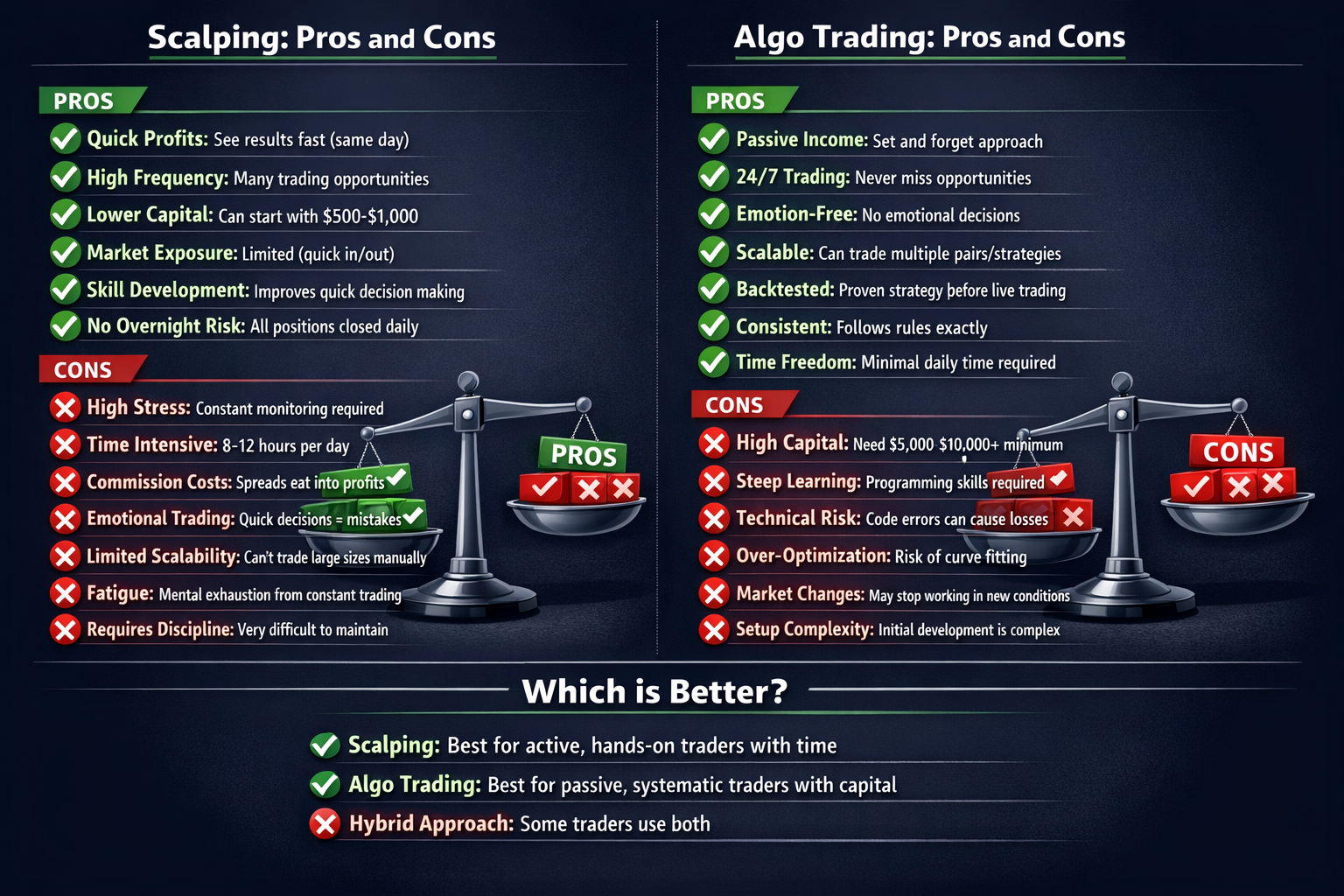
Scalping Pros
- Higher profit potential: Can achieve 20-30% monthly returns with skill and discipline
- Lower capital requirement: Can start with $500-$2,000
- Faster learning curve: 6-12 months to proficiency
- No programming needed: Uses standard trading platforms
- Immediate feedback: See results of decisions quickly
- Full control: Every trade decision is yours
Scalping Cons
- Time intensive: Requires 8-12 hours daily commitment
- Emotional stress: High-pressure, fast-paced environment
- High transaction costs: Spreads eat into small profits
- Limited scalability: Can't easily scale without more time
- Fatigue risk: Mental exhaustion leads to mistakes
- Requires optimal conditions: Only profitable during specific market hours
Algo Trading Pros
- Passive income: Minimal daily time commitment (15-30 minutes)
- Emotion-free: No emotional interference in trading decisions
- 24/7 operation: Trades across all market sessions
- Highly scalable: Increase capital without more time
- Backtested strategies: Test before risking real capital
- Consistent performance: Systematic execution reduces variability
Algo Trading Cons
- Higher capital requirement: $5,000-$20,000+ recommended
- Steep learning curve: 12-24 months to proficiency
- Programming skills needed: Requires technical knowledge
- Initial development cost: $1,000-$5,000+ for setup
- Lower monthly returns: Typically 5-15% vs 10-30% for scalping
- Requires maintenance: Algorithms need monitoring and optimization
Real Performance Statistics
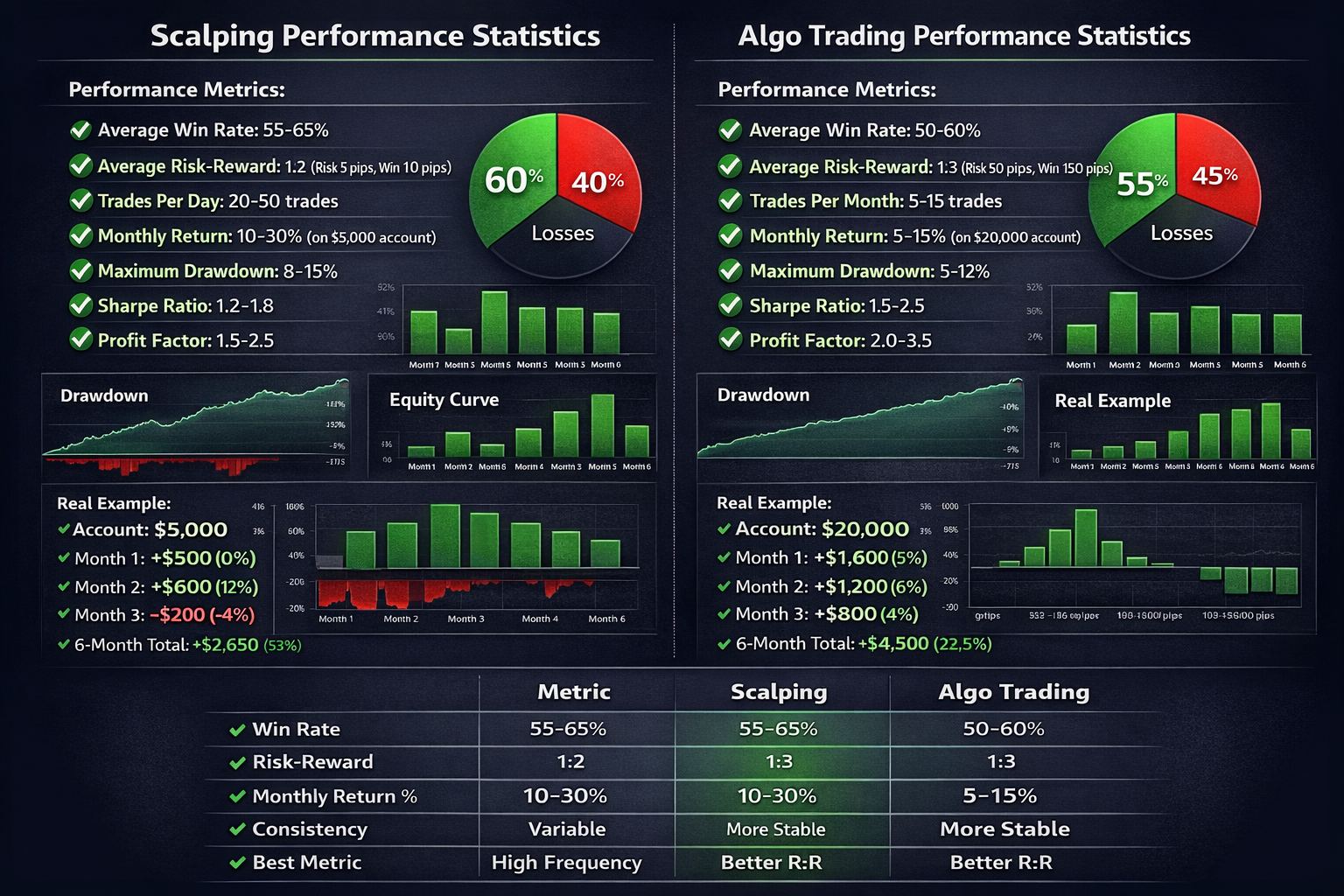
Understanding realistic performance expectations helps you make informed decisions. Here are typical performance metrics for each strategy based on real-world trading data and industry standards.
Scalping Performance Metrics
Monthly Return (Skilled Trader)
10-30%
Win Rate
55-65%
Average Trade Duration
1-5 minutes
Trades Per Day
20-100+
Risk-Reward Ratio
1:1 to 1:1.5
Maximum Drawdown
15-25%
Algo Trading Performance Metrics
Monthly Return (Well-Designed System)
5-15%
Win Rate
45-55%
Average Trade Duration
Hours to Days
Trades Per Day
1-10
Risk-Reward Ratio
1:2 to 1:5
Maximum Drawdown
10-20%
Important Performance Notes:
- These are optimal performance metrics: Most traders achieve lower returns, especially during learning phases. Only experienced, skilled traders consistently achieve these numbers.
- Past performance doesn't guarantee future results: Market conditions change, and strategies that worked in the past may not work in the future. Continuous adaptation is required.
- Transaction costs matter: All performance metrics assume optimal execution and competitive spreads. Higher costs significantly reduce returns, especially for scalping.
- Risk management is critical: These returns are only achievable with strict risk management. Traders who risk too much per trade will experience larger drawdowns and potential account blowouts.
Who Should Choose What?
Not every trader is suited for every strategy. This decision guide helps you identify which approach aligns with your personality, lifestyle, goals, and circumstances. Making the right choice from the start saves time, money, and frustration.
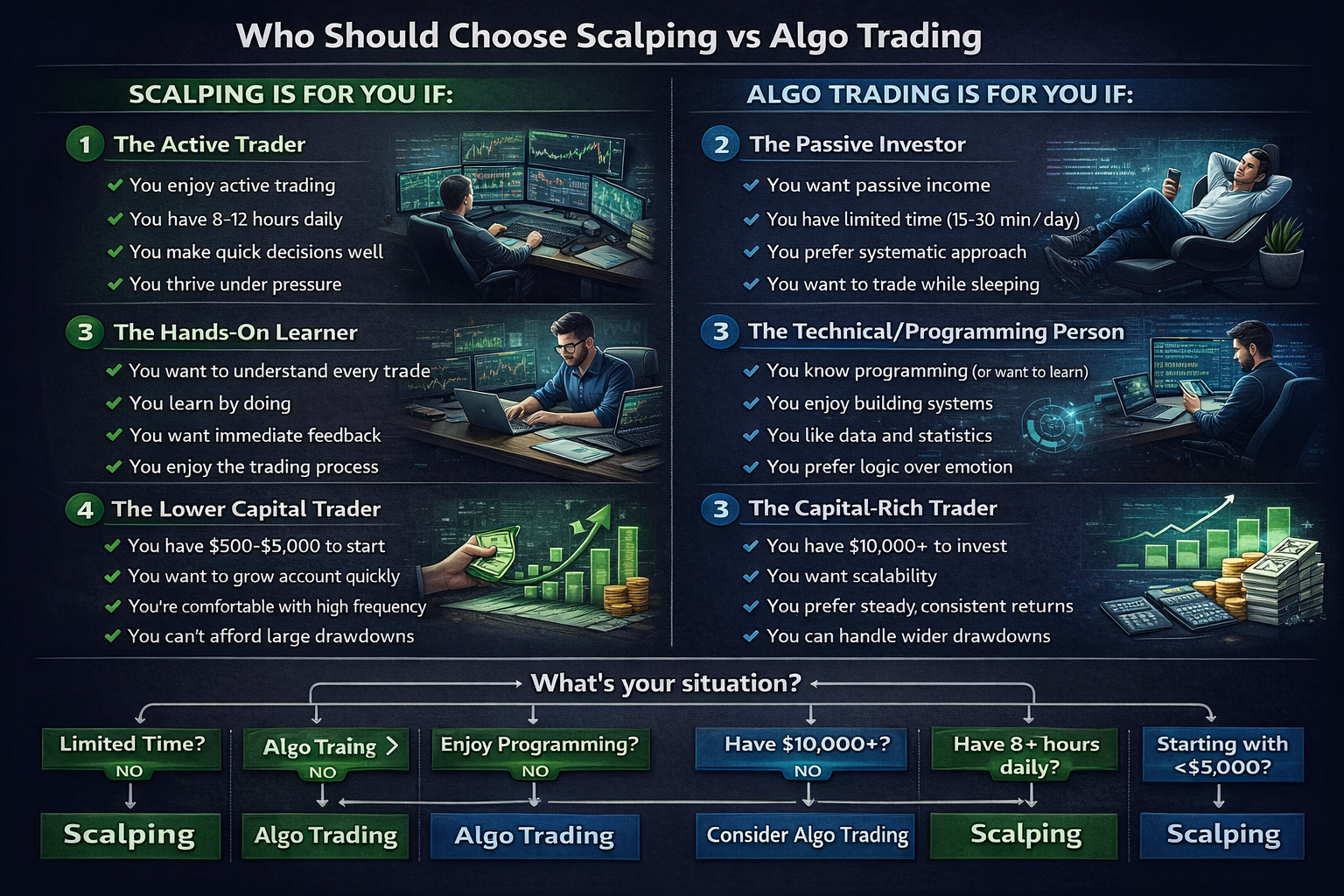
Choose Scalping If:
- You have 8-12 hours daily to dedicate to active trading and can maintain focus for extended periods
- You thrive under pressure and make quick decisions well under stress
- You have limited capital ($500-$5,000) and want to start trading immediately
- You prefer active control over every trade decision and enjoy the excitement of fast-paced trading
- You don't have programming skills and don't want to invest time learning
- You can trade during optimal hours (London-New York overlap) consistently
- You have strong emotional discipline and can handle frequent wins and losses without emotional impact
- You're looking for higher returns and are willing to accept higher risk and time commitment
Choose Algorithmic Trading If:
- You have limited daily time (15-30 minutes) but can invest 10-20 hours weekly in development
- You prefer systematic approaches and enjoy problem-solving and technical challenges
- You have higher capital ($5,000-$50,000+) to invest in development and trading
- You want passive income and the ability to trade while maintaining other commitments
- You have or can learn programming skills (or can hire developers)
- You prefer consistency over high returns and value steady, predictable performance
- You want scalability - the ability to increase capital without proportionally increasing time
- You can wait 12-24 months for systems to be developed and optimized before seeing significant returns
Decision Framework:
Ask yourself these questions to guide your decision:
- Time Availability: Can you commit 8+ hours daily (scalping) or 15-30 minutes daily (algo)?
- Capital: Do you have $500-$5,000 (scalping) or $5,000-$50,000+ (algo)?
- Technical Skills: Are you comfortable learning programming, or do you prefer manual trading?
- Personality: Do you thrive under pressure (scalping) or prefer systematic approaches (algo)?
- Goals: Are you seeking maximum returns (scalping) or passive income (algo)?
- Lifestyle: Can you trade during specific hours (scalping) or need flexibility (algo)?
Hybrid Approach: Best of Both Worlds
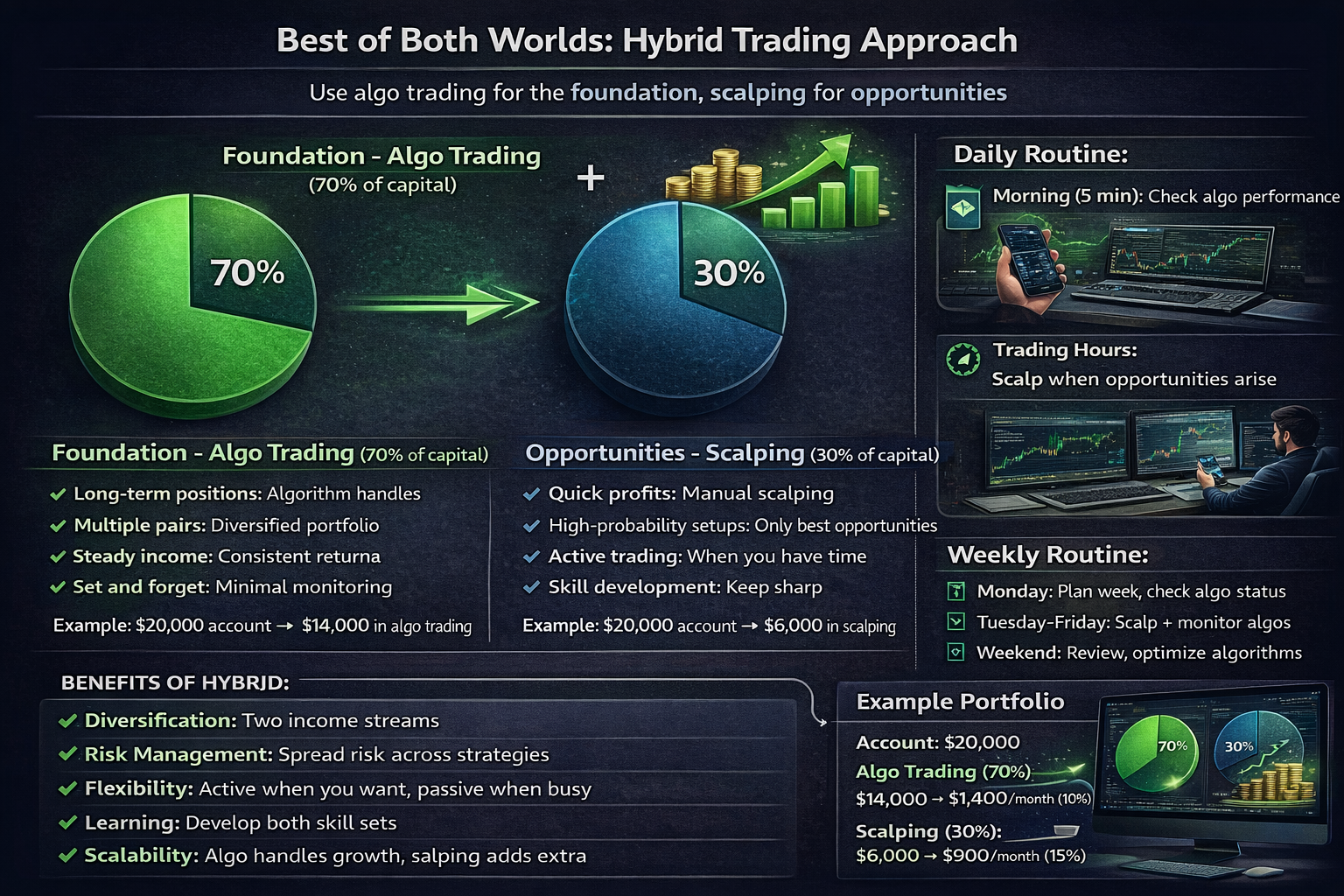
Many successful traders combine both strategies for optimal results. A hybrid approach offers diversification, risk management, and the benefits of both active and passive trading. This strategy allows you to leverage the strengths of each approach while mitigating their individual weaknesses.
Recommended Hybrid Allocation
A common and effective hybrid approach allocates capital as follows:
- 70% in Algorithmic Trading: Provides steady, passive income with minimal time commitment. This forms the foundation of your trading income, generating consistent returns while you sleep or focus on other activities.
- 30% in Manual Scalping: Allows you to actively trade during optimal conditions, capture quick opportunities, and potentially achieve higher returns during favorable market periods.
Benefits of Hybrid Approach
- Diversification: Reduces overall portfolio risk by spreading capital across different strategies and timeframes
- Income Stability: Algorithmic trading provides consistent baseline income, while scalping offers potential for higher returns
- Flexibility: You can scale back scalping during busy periods without affecting algorithmic trading income
- Learning Opportunity: Active scalping helps you understand market dynamics, which can improve your algorithmic trading strategies
- Risk Management: If one strategy underperforms, the other can compensate, reducing overall drawdown risk
- Emotional Balance: Passive algo income reduces pressure on scalping performance, allowing for better emotional control
Implementation Strategy
To implement a hybrid approach effectively:
- Start with Algorithmic Trading: Develop and deploy algorithms first to establish passive income foundation. This typically takes 12-18 months.
- Add Scalping Gradually: Once algorithms are profitable, allocate a portion of profits to scalping capital. Start with 10-20% and increase as you gain experience.
- Maintain Separate Accounts: Keep algorithmic and scalping capital in separate accounts for better tracking and risk management.
- Monitor Performance: Regularly review both strategies and adjust allocation based on performance and market conditions.
- Scale Strategically: As total capital grows, maintain the 70/30 ratio or adjust based on your time availability and goals.
Example Hybrid Portfolio:
With a $20,000 account:
- $14,000 in Algorithmic Trading: Deployed across 2-3 algorithms on different currency pairs, generating 5-12% monthly returns ($700-$1,680/month) with 15-30 minutes daily monitoring
- $6,000 in Manual Scalping: Active trading during optimal hours, targeting 10-20% monthly returns ($600-$1,200/month) with 4-6 hours daily commitment
- Combined Monthly Income: $1,300-$2,880 (6.5%-14.4% monthly return) with balanced time commitment and risk
Conclusion: Making the Right Choice
Choosing between scalping and algorithmic trading depends on your personal circumstances, goals, and preferences. There's no one-size-fits-all answer, but understanding the differences helps you make an informed decision that aligns with your lifestyle, skills, and financial situation.
Key Takeaways:
- Scalping is best for active traders with time, lower capital, quick decision-making skills, and the ability to handle high-pressure trading environments. It offers higher potential returns (10-30% monthly) but requires 8-12 hours daily commitment.
- Algo Trading is best for passive traders with programming skills (or developer access), higher capital, systematic approach, and desire for passive income. It offers consistent returns (5-15% monthly) with minimal daily time (15-30 minutes) after initial development.
- Hybrid Approach combines both strategies for diversification, risk management, and optimal income potential. Allocate 70% to algo trading for stability and 30% to scalping for active opportunities.
- Both strategies require proper risk management: Never risk more than 1-2% per trade, use stop losses, maintain discipline, and continuously learn and adapt your approach.
Remember, successful trading isn't about choosing the "best" strategy—it's about choosing the strategy that fits your lifestyle, skills, and goals. Whether you choose scalping, algo trading, or a hybrid approach, focus on proper risk management, continuous learning, and disciplined execution.
Start with paper trading to test your chosen strategy without risking real capital. Develop your skills, refine your approach, and only transition to live trading when you've proven consistent profitability in simulated environments. The path to trading success requires patience, discipline, and a commitment to continuous improvement.
Related Articles
Put This Knowledge Into Action
Explore SignalWavesAI tools and start applying what you've learned with professional forex signals.